Sample Speed Training Phase for High School Coaches
A Real-World Companion to Movement Prep and “What You Can Do for Your Athletes Right Now”
Introduction
This article is a companion to two key pieces in our Precision Performance Concepts series:
-
[What You Can Do for Your Athletes Right Now →] (practical coaching strategies)
What follows is a real-world example of a speed training session. It was built from a midday workout I ran between clients in classic South Texas heat. It’s fast, effective, and easy to adapt for high school athletes, individual sessions, or team practice.
Speed Prep Phase: Fast-Twitch Activation
Before any sprint session, the nervous system needs to be ready.
This is not cardio. This is neurological activation.
It’s about flipping the switch from idle to high voltage.
For this session, I followed Tony Holler’s “Feed the Cats” atomic workout format. That means 5 to 8 seconds of maxed-out, dialed-in effort, followed by 50 seconds of walking or full recovery.
Quick reminder:
Speed work must be done without fatigue.
We want intent, focus, and energy at their peak.
This isn’t muscular. It isn’t cardiovascular.
It’s neurological. It’s about turning up the brain-body connection.
For those few seconds, think AMPLIFY.
For those few seconds, think BOUNCY.
Those two words should echo in the athlete’s mind every rep.
🔹 Drills (5–6 seconds each)
-
Speed Marches
-
High Knees
-
Low Skips
-
High Skips
-
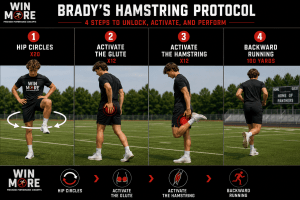
Backwards Running
-
Pogo Jumps
-
Box Jumps
-
Prime Time: Fast Feet
-
Prime Time: Long Stride
-
Prime Time: Regular Stride
For coaches:
These 10 drills were selected to support linear sprinting mechanics. That’s the pattern I was training.
But if you coach tennis, baseball, volleyball, gymnastics, or any sport with multidirectional needs, you may want to adjust these drills between sessions.
As I say in my book Unlocking Athletic Potential:
“I’ll never tell you how to coach. I’m here to give you templates, tools, and awareness so you can do your job better.”

Experiment.
Observe.
Refine.
Find what works for your athletes, in your environment.
Speed Training Phase: The Real Work
After the prep block, I moved into true sprint work.
8 to 10 reps of 10-second sprints
with 1 minute and 50 seconds of rest between each
Recovery isn’t a break. It’s part of the session. Without it, you’re not training speed. You’re conditioning.
🔹 My Actual Outcome:
-
Completed 8 total sprints
-
First 6 were “green light” reps with full form, effort, and speed
-
Reps 7 and 8 showed a slight drop—my form dipped and my heart rate didn’t recover like it should
That’s when I shut it down. Not because I was tired, but because I was leaving the speed phase and crossing into something else.
This wasn’t a conditioning day. This was built for max output.
It doesn’t look like much on paper, but it was exactly what I needed that day.
I used my Traffic Light System to monitor performance.
It’s fully explained in Unlocking Athletic Potential and discussed in the article [What You Can Do for Your Athletes Right Now →].
This is one of the simplest and most effective tools for teaching athletes how to self-monitor and make smart training decisions.
Coaching Takeaways
If you’re running this with your team, here’s what matters most:
-
Sprint fresh. Stop before form fades.
-
Full recovery is essential. No skipping it to save time.
-
Effort doesn’t equal output. Clean reps matter.
-
Don’t let fatigue sneak in. You’re building speed, not just surviving effort.
Conclusion
This is a fast, clean, and powerful session.
It hits the nervous system, sharpens form, and respects recovery.
It also ties directly into everything we’ve already laid out.
-
You’ve learned how to prep the body.
-
You’ve seen how to help athletes improve right now.
-
And now you have a real-world model for building speed that sticks.
Want visuals for Prime Time drills?
Need a downloadable version for your athletes or staff?
Want this built directly into your weekly training blocks?
Let me know. You’ve got the tools. Use them.
Precision Performance Concepts
Built for the modern coach. Backed by experience.
want the book? https://books.by/precision-performance-concepts