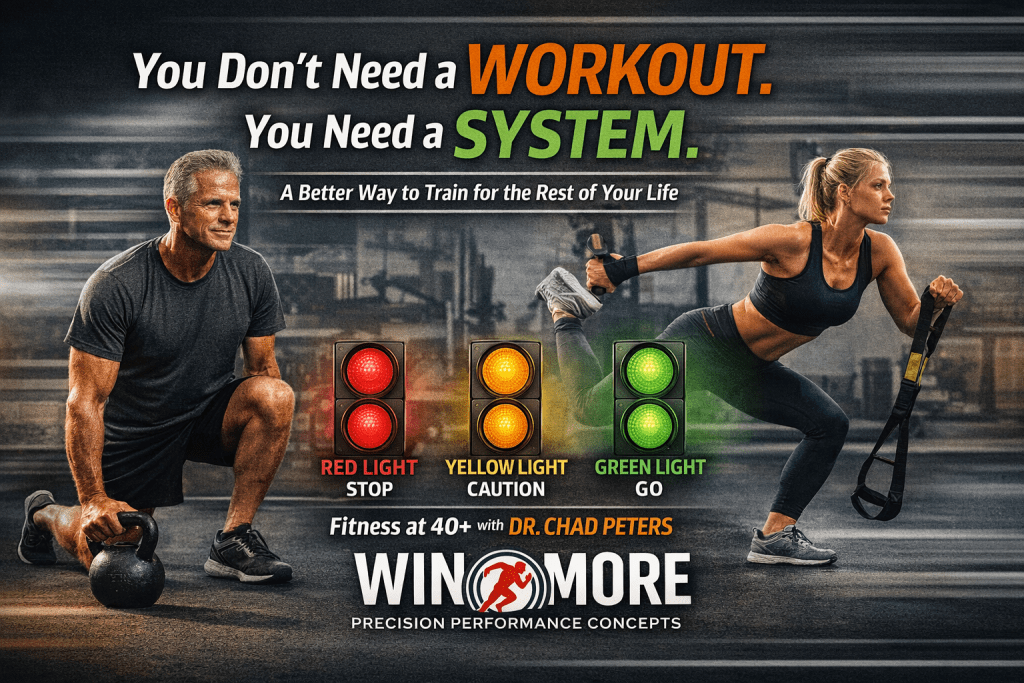
You Don’t Need a Workout. You Need a System.
A better way to train for the rest of your life
Part 1 of the “Fitness at 40+” Series — Dr. Chad Peters, Precision Performance Concepts
I’ve been down this road many times in my career. As both a sports-based chiropractor and a performance specialist.
I live in the overlap between the two.
And I see these cases every single day.
This week, a client pushed me to be better.
So let me start this series with the story that explains it all.
A fit and healthy 70-year-old man walked into my clinic and told me something that stuck.
He said he feels better now than he did when he first retired.
Not because he found some magic program.
Not because he started training like a 25-year-old.
More than anything, he finally had time and wasn’t tied to a desk anymore.
So he started moving again.
Lifting a little. Trying.
He had even stepped things up at the athletic club… and after a tough week nursing an injury, he asked the question most people eventually ask:
“Where do I go from here?”
That’s not a quick answer.
So I asked him:
“Injury-wise? Health-wise? Workouts? Nutrition? Aging? What are you actually asking?”
He said:
“All of it. I want to get better… and I don’t want to waste time.”
There’s a reason I don’t do TikTok.
The questions that actually matter don’t fit into a 60 second video answer.
And the answer to that question—where do I go from here—isn’t something you solve with a list of exercises.
I’m not here to give you a workout.
This kind of change doesn’t even fit into one article.
So we’re going to build this as a series.
Because instead of telling you what to do…
I’d rather change the way you think about working out.
Fitness and health is much more than stretch out what is tight and strengthen what is weak.
1) Start With the Question Nobody Asks
Why are you training?
Most people skip that step.
They say:
- “I need to get in shape.”
- “I need to lose weight.”
- “I need to move better.”
Then they grab a plan.
Or copy what someone else is doing.
And they usually fall into one of two traps:
- If it’s hard, it must be right
- Or if it’s too hard, it must be dangerous
Somewhere in there, they land on:
“Five days a week, two hours a day—that’s what it takes.”
But not all hard work leads to the same place.
You need a better why.
A bodybuilder trains differently than a powerlifter.
A high school athlete trains differently than a weekend golfer.
And someone who just wants to feel good when they get out of bed in the morning…
should not be training like they’re trying to make the team.
I don’t care if you’re 30, 40, 60, or 70+—if your goal isn’t to make the team, your workout deserves an appropriate shift.
Take some time and define it. And if the answer is, I want to stop aging and move better. or I’m tired of being in pain, the system cannot match what a 16-year-old tennis player uses!
So make a plan based on not one goal but three or four canons of your personal health.
2) The Athletic Club Mentality (The Big 4)
Most gyms still operate on the same scoreboard:
- How strong are you?
- How’s your cardio?
- What’s your body composition?
- How flexible are you?
And to be clear—it works.
If you stay consistent, you can improve those numbers.
You can look better. You can feel better… for a while.
But there’s a problem.
You can spend a lot of time and energy improving those numbers…
and still end up stiff, sore, and one bad workout away from taking a few weeks off.
You can waste a lot of time and energy with the idea of work.
So the real question becomes:
What if the problem isn’t that you’re not working hard enough…
but that you need a better definition of what work actually is?
A Better Way to Think About It
There aren’t just four components to fitness. There are dozens.
And sometimes the biggest improvement doesn’t come from doing more…or from getting stronger.
It comes from changing your personal definition of what work looks like.
Movement must come first! every day (see below!)
This isn’t the article for a list or a program but to set an example, I think a glimpse at my week might help you with a better decision and end the warmup, cardio, workout, cool down.
Monday – for me it’s all about movement, the entire workout – I do “get ups”, burpees, sit outs, maybe a yoga or qigong 20-30 min and mob/stability.
Tues – Sprints first, then I want to keep Groth Hormone and T spiked, so cardio EMOM and big body parts; squats, hex bar dead (heavy)
Wed – “Grandma at the mall” – I walk two miles or so with weights, doing a full body workout while walking. (silly but effective!)
Thurs – Body building type workout (the only day that looks like a traditional “workout.” I’ll often sub a very difficult HIIT (time under tension w/o)
Fri or Sat – functional strength – KB’s, farmers carry, sandbags, burdens, atlas stones – strong man type stuff
We don’t warm up. We unlock.
This isn’t about getting a sweat going.
It’s about preparing your body to move the way it’s supposed to.
Not jogging a lap.
Not passive stretching.
Real movement—focused on the areas that drive everything else:
- Hips
- Shoulders
- Foot and ankle
These are your primary engines.
Even from a clinical standpoint, it’s obvious:
the body isn’t limited by the spine—it’s limited by how well the major moving pieces function.
If you want to maximize fitness…
this is where it starts.
We don’t chase flexibility and strength. We build mobility—and then stability prior to everything else!
Flexibility is passive.
Mobility is active, controlled.
One lets you get into a position.
The other lets you own it.
Then comes stability.
Stability is what allows you to hold that position and repeat it.
And those two—mobility and stability—have to come before strength.
In my book on building athletic performance, this is foundational.
Strength, speed, acceleration, change of direction—all of it—
depends on having permission from mobility and stability first.
Skip that step…
and you sabotage your own progress before you even begin.
to be fair, it’s not as fun as the “workout.” Not as cool, doesnt feel as immediate and good, and isn’t instant. But if your goals are to move better, it’s a foundation that can’t be skipped – not if you want to last.
3) We don’t just lift weights. We build strength through movement.
Strength in a straight line has its place.
But real life doesn’t happen in perfect positions.
You don’t pick up your kids, carry groceries, or surf in a squat rack.
You move.
You reach.
You rotate.
You react.
Your strength should reflect that. To be fair, my workouts look nothing like what I was doing as a college football player. That’s just not what my workouts are for anymore. So sure, I’ll do some squats or bench press but I do it because I love it and it’s a test of my manhood and a snapshot of my strength, but for my day-to-day stuff – nope – I’d probably not be allowed into a health club with the movement stuff I do. I’m chasing different results.
This is where functional strength becomes real—not a buzzword.
You’re not just building muscle.
You’re building strength for what you actually do.
Every exercise is either an asset… or a detriment
Every rep you do is moving you in one direction or the other.
If your body is prepared for it, it helps.
If it’s not, it slowly works against you.
Two people can do the exact same workout—one gets better, the other gets hurt.
The difference isn’t effort.
It’s direction.
Think about it like this:
If your hip is bothering you and you decide to “strengthen it” with squats, lunges, and step-ups…
you’re not wrong.
Unless the hip isn’t moving well to begin with.
Now those same exercises are grinding the joint over and over again.
The same thing happens with the classic:
“You need to strengthen your core.”
How’s that worked out for most people with back pain over the last few decades?
4) A Quick Reality Check on Body Composition
Body composition matters.
It affects your health, your longevity, and how you feel.
But if losing weight and gaining muscle is your primary goal, we need to be honest:
That’s built in the kitchen—not the gym.
Better decisions beat better workouts.
We’ve been misled on this for decades.
If you want to look better and drop weight…start with your diet. Every time.
It’s not complicated. It’s just not easy.
Make better decisions.
You Don’t Need a Program
You don’t need another 4-week plan.
You don’t need a list of 26 exercises.
You need a system.
Not one you memorize.
One you understand. One that you look forward to, because it makes you better.
A way of thinking that allows you to adjust based on:
- how you feel
- how you move
- what you actually need
Because here’s the reality:
Some days, you should push.
You need those ass-kicker, knock-down, drag-out workouts once in a while.
To test yourself. To compete—even if it’s just with yourself.
But if you train like that every day?
It’s wasteful.
And you’ll miss more days than you hit.
On the other side—
if you never push hard enough to reach a real training threshold…
that doesn’t work either.
There’s a middle ground. And most people have no idea how to find it. From my book, “Unlocking Athletic Potential”
Where This Is Going
Over the next few articles, I’m going to walk you through a system that actually works in the real world.
Not just for athletes.
For anyone who wants to:
- move better
- stay strong
- avoid breaking down
- and feel like their body is working with them—not against them
We’ll cover:
- What “move better” actually means—and why it comes first
- How to build tolerance so your body can handle what you ask it to do
- What real strength looks like outside the gym
- And how to adjust your training day-to-day using a simple system most people have never been taught
(We’ll link each of these as they’re released.)
Last year, I wrote a book on athletic performance for high school athletes.
Different audience. Different goals.
But the principles didn’t change.
Because whether you’re 17 or 70…
your body still plays by the same rules.
The difference is what you’re asking it to do.
And that brings us back to the question:
Where do you go from here?
You stop chasing workouts.
And you start building a system. It’s so much more (and easier) that stretch and lift – if you want to avoid wasted time, get that message first!