Four Ways to Change Your Team by Game Day
30 Minutes. No Fluff. Just What Works.
By Dr. Chad Peters, DC | Precision Performance Concepts
After spending a year building Unlocking Athletic Potential: A Coach’s Guide to Peak Performance, I’ve started running live seminars that cut right to it:
“What can we do right now to make a difference in our team by Game Day?”
That was the request I got this week.
And in a half-hour?!
This presentation needs to be quick and effective. Real talk only. So here’s what I gave them:
Four hard-hitting changes any coach can implement immediately.
1. Movement Prep: The Order Has Changed
It’s not a warmup anymore. In fact, the word itself needs to die.
Warmups are lame and half assed – It’s called Movement Prep in the industry. As a coach, adopt that!
We’re not here to “loosen up.”
In the performance world, that’s called downregulation—and that’s exactly what we don’t want at the start of training.
Static stretching? That’s not a part of a modern warm-up and movement prep. Stretch is primarily just a reset tool, used after stress to bring the system back down.
In modern athletics, it has a place—but not at the adult table. It’s at the end of the session, not the start, and really, only if needed due to stress, injury, or a specific need.
More than anything, get this. The order and priority of creating athletes has changed.
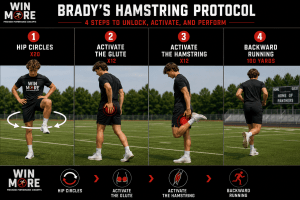
Start your session with movement prep built around the “3 BIG Engines”:
- Hips
- Shoulders
- Ankles
Mobilize first. Activate second.
Every single time. (Need help on this? click here!)
This primes the nervous system and preps the engines that matter most.
If your athletes aren’t moving well, they’re not accessing their energy systems. Period. It’s called a bleed out/leak in the industry.
Without quality movement = Less than optimal output.
That’s POTENTIAL left on the table. So prep correctly, then train.
2. In Elite Training, Speed Comes First
Speed isn’t the muscular system.
It’s not cardiovascular.
It’s neurological.
Think electric system. Think sharp, reactive, twitchy.
Speed is the one variable that shows up in every single sport—and it’s also the one thing that most athletes don’t train optimally.
Train it first. Always.
Speed work demands:
- High intent
- Max energy for short bursts
- Full rest between reps
- Buy-in from the whole room
It’s not conditioning. It’s not punishment.
It’s a high-skill movement pattern that builds precision, power, and explosiveness.
🧠 “Seek to identify what fast athletes can do that slow athletes cannot—and focus on that.” – Mike Holler, Feed the Cats
(check out his “Atomic Workout” as a much improved version of the old dynamic warmup)
Start with “BOUNCY.” Train rhythm. Sharpen the system.
Speed Kills. Speed wins.
3. Smarter Weight Room in 2 steps: Auto-Regulation and Traffic Lights 🔥
With weight training, there are usually three focus points:
- Strength
- Power
- Hypertrophy
For most high school programs, my recommendation is a little uncommon—but for good reason.
Choose hypertrophy.
Here’s why:
- It gives you the best of all three: strength, size, and output
- It better matches where most high school athletes are hormonally and experience
- It ramps up fast, with lower injury risk than pure power development
Power requires a prolonged ramp-up to teach proper technique. For some athletes, it’s the right choice. For the majority, hypertrophy gets us faster results with less downside.
Now let’s make it work smarter.
Upgrade #1: Auto-Regulation
Auto-regulation lets your athletes self-correct each set while still targeting the goal of the lift.
If the program says 4×10, here’s how you run it:
- ✅ Hit 10? Great. You nailed the workout’s intent. Stay there.
- 🔼 If you can Hit 12, do it. Go up 2–5% on the next set. You’re ready.
- 🔽 Hit 8 or less? Drop 15–20%. Get the reps back in the intended zone.
This keeps technique clean and progress intentional. We’re not chasing numbers, we’re chasing results than impact!
Upgrade #2: Traffic Light Self-Assessment 🚦
After each lift, athletes call out their color:
- 🟢 Green: Perfect form, no breakdown
- 🟡 Yellow: Something was off
- 🔴 Red: Ugly rep or pain
This isn’t just feedback—it’s buy-in. Your weight room should sound like this:
“4×10, all green lights. Let’s go!”
Multiple yellow lights = a deeper look
Red lights = a problem. It could be weight room stuff such as cheat reps, pain, poor form etc, but is often due to something less identifiable – a tough breakup, loss of a family member/pet, poor nutrition, exams and class load or just having an off day. Coaches see this every day and can help fix this.
Red lets you identify when training is an asset or a detriment.
4. Conditioning: The Hidden Problem Most Coaches Miss
This one’s going to sound blasphemous…
Most high school teams are already over-conditioned.
Practice sessions already include more than enough volume. Typically 2-3x the volume of game day.
If your team is fading in the fourth quarter, it’s probably not a conditioning issue.
It’s fatigue. But not the kind you think.
It’s:
- Neurological fatigue
- Movement fatigue
- Mental fatigue
- Breakdown in mechanics
- Decision making collapse
More line drills won’t fix that.
Better training will. Awareness will.
Let practice give you the volume.
Let your program build resilience.
Stop hammering the wrong nail.
Train what wins. Don’t bury it in extra laps.
Final Recap: What Hits NOW
You wanted something that works right now—here it is:
- Movement Prep: Three engines. Upregulate. Move clean.
- Speed First: It’s neurological. Full rest. High priority.
- Weight Room: Hypertrophy, auto-regulation, and instant set by set feedback.
- Conditioning: Let practice do it. Train what matters most.
When you upgrade these areas, you’ll handle 90% of performance needs.
Now get back to coaching the game you love!
That’s where you win games.

- for a more extended look at each of these topics and a whole lot more – look into Dr. P’s new book https://books.by/precision-performance-concepts