High School Girls 10-Week On-Ramp Training Session
This session is part of the Precision Performance Concepts Seminar Series. It comes from a real-world request.
A high school girls basketball coach asked how to structure a program leading into the season.
With 10 weeks before tip-off, she wanted a plan to maximize athletic performance and build momentum.
first thing first – this is not the off-season!
The off-season is the summer. That is the time to build the base and the foundation of strength and general athleticism.
The on-ramp is different.
This phase is about sharpening the tools, adding focus, and preparing athletes to compete. It should have better direction than a baseline strength block. The goal is to arrive at the season healthy, fast, and explosive, not simply stronger.
The Hierarchy of Performance
At PPC, we believe every athlete benefits from a simple hierarchy:
-
Mobility comes first. Without mobility, athletes are restricted, inefficient, and more likely to break down. Daily and pre-game.
-
Speed training second. True speed is trained with full rest, full recovery, and high intensity. I would use the basics of this phase daily, even prior to games.
-
Strength and development third. Once mobility and speed are in place, the weight room builds resilience and confidence.
Phase 1: Mobility Prep
Mobility primes the body for everything that follows. We target the three big engines: hips, shoulders, and ankles.
Mobility Drills (20 reps each)
-
Hip Circles – smooth, controlled range of motion
-
Cuban Presses / Arm Circles – open shoulders, prep for pressing and shooting
-
Ankle ABCs – trace the alphabet with the foot, build ankle mobility and control
Activation Work (10 reps each)
-
Hips: Glute and hamstring contractions. Athletes put a hand on the muscle and feel it fire.
-
Shoulders: Trap and rhomboid contractions. Band rows optional, but effort must come from active muscle engagement, not empty movement.
-
Ankles: Calf raises and soleus raises with knees bent at 45°.
Why It Matters
Mobility alone is incomplete. The follow-up activation ensures the nervous system connects brain to muscle. That connection unlocks performance.
Mobility = performance
A tenth of a second faster reaction equals two extra feet on the court. A two-foot advantage every possession changes games!
Mobility and activation should take 5–6 minutes total. (I’ll often give the athletes 10 minutes – the extra time is build for their individual needs, some girls might need to work on their knee and use a voodoo band, some might want to foam roll their back or thoracic. You get it!)
Phase 2: Speed Prep (Atomic Warm-Up)
This is not a “dynamic warm-up.” This is speed preparation. We use Coach Tony Holler’s Feed the Cats Atomic Workout as the model. why? because it changed my athletes. The teams that try it are typically sold.
-
5 seconds on, 55 seconds rest
-
10 total exercises
-
About 9:05 minutes total (these 5 seconds are MAXED OUT!)
Core 10 Drills
(my sample – I added extra as each coach has preferred needs and a little variety keeps the focus sharp.)
- High Marches
-
High Knees
-
A Skips
-
Modern Butt Kicks (pull glute -pull hamstring emphasis)
-
A-Skip
-
Pogo Jumps
-
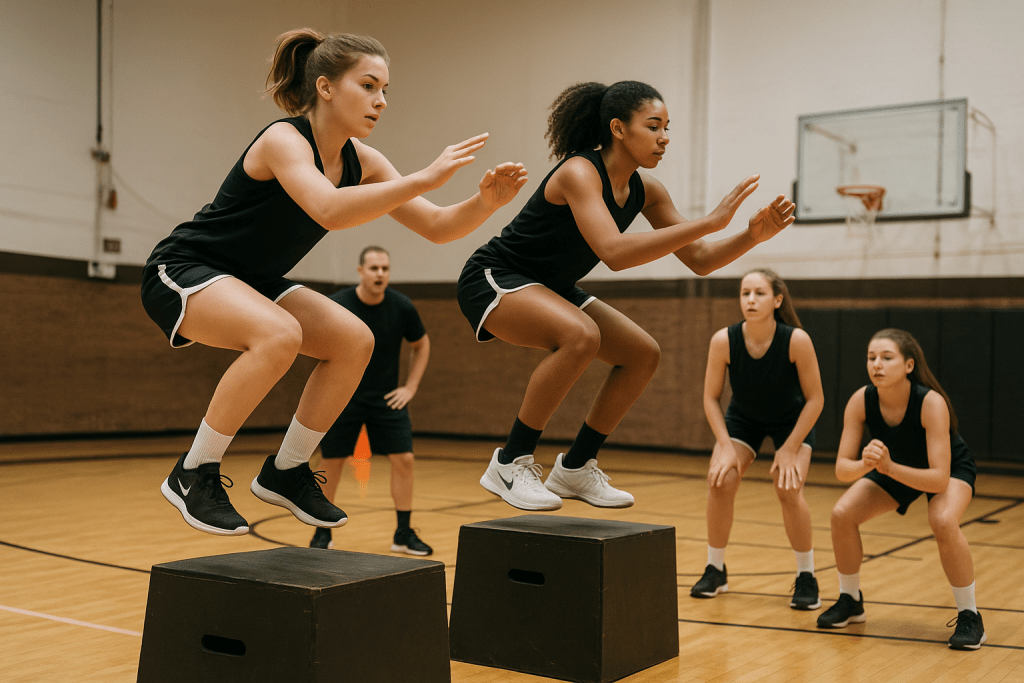
Box Jumps
-
Prime Times – short
-
Prime Times – long
-
Prime Times – regular or backward sprint
Basketball-Specific Options
-
Backwards pivots and turns
-
Single-leg focus (right-only, left-only)
-
Low outside hand touches into acceleration
-
Grapevine footwork with knee drive
This entire phase amplifies the electrical system. Athletes feel sharp, reactive, and fast before the “real work” even begins.
(as a coach, I am confident you’ll see a completely different result and practice than what a warmup provided!)
Phase 3: Weight Room Focus
Here’s where most coaches think the magic happens. The weight room is critical, but remember — the real magic starts in mobility and speed prep.
When I lecture, I remind the coaches,
“Every team lifts. None of the teams prep like you just did. You’re looking for what lets you take a step away from everyone correct?”
The weight room builds resilience, horsepower, and confidence.
For this 10-week phase we focus on hypertrophy and strength.
Prime Lifts (3 days per week and mix up your focus)
Prime lifts are the multiple body part, more weight, big movers)
-
Hex Bar Deadlifts (probably more like 4 x 6)
-
Dumbbell Lunges
-
Bench Press
-
Coach’s Choice (athlete favorites keep buy-in high)
Prescription: 4×10 with auto-regulation. Use the “green light” rule — push when you are able to, back off when not.
Why Hypertrophy?
In a short 10-week window, high school girls will not see meaningful power gains. the teaching window for power is just to olong and honestly, the age of the girls and the experience just don’t make this my favorite pic. Also, Basketball and volleyball already demand explosive power.
The weight room should instead target hypertrophy, body comp. and general strength. Stronger muscles make athletes more resilient and more confident. We can certainly get that in 10 weeks.
Auxiliary Work (rotation throughout the week) typically 3 x 10
-
Shoulders
-
Calves
-
Biceps and Triceps
-
Abs and Core
This keeps training well-rounded and gives visible changes. Athletes see results quickly, which drives motivation and buy-in.
Phase 4: Auxiliary “Explosion” Days
The two auxiliary days are not conditioning punishments. They are high-energy, fun, and explosive. Think of them as basketball-specific power labs.
Explosive Focus
-
Box Jumps
- Hex bar speed reps (takes some training!)
-
Hurdles
-
Plyometrics
-
Basketball-Specific Drills:
-
Jump into a shot
-
Cut to the corner and shoot
-
Catch-and-react drills
-
Conditioning (Modern Approach)
-
Burpees, Get-Ups, Sit-Outs
-
Stadium or Bleacher Sprints (short, sharp, sprint-based)
-
Small circuits that are explosive, not draining
Culture and Coaching Moments
Recovery periods are teaching time. Coaches can drop small lessons that stick:
-
“A pass to the chest is a pro pass. To the hips is varsity. To the knees is JV. Details separate levels.”
-
“Our standard is not to be okay. Our standard is to win.”
- “How do you feel? We’re not beating you down – we’re building you UP!”
These subliminal culture hits transform rest time into coaching gold. Coach! That’s what yu do best and in high school you just don’t have meeting room time.
Phase 5: Recovery / Reset Option
If the athletes are fried, pivot to recovery.
-
Yoga: Try Yoga with Adriene on YouTube.
-
Sports Mindset Meditation: Guided breathing and visualization.
It may sound corny. Try it. Observe the results. Pro teams everywhere use this secret sauce to build focus and reset.
Ask the one question that matters:
Will today’s session be an asset or a detriment to my team?
If the girls are fried, tired, beat up, mentally gone from exam week etc. A reset might be the best call!
Sample Weekly Template
Monday – Weight Room (Lower Body)
-
Hex Bar Deadlifts, Dumbbell Lunges, Core work
Tuesday – Auxiliary Power Day
-
Box jumps, plyos, basketball-specific explosive drills
-
Subliminal coaching during recovery
Wednesday – Weight Room (Upper Body)
-
Bench Press, Rows, Shoulder work, Arms
Thursday – Auxiliary Power Day
-
Hurdles, reactive cuts, game-specific speed drills
Friday – Weight Room (Power & Integration)
-
Lunge/Jump variations, medicine ball throws, core
Recovery / Reset (Optional)
-
Yoga or mindset training
The PPC Philosophy
At Precision Performance Concepts, our mission is not to tell you how to coach. You already have a system.
We exist to make you aware of ideas that amplify what you are doing. Think of this as premium fuel, not a replacement engine.
Use what you already have, but use it in a better, more effective way.
Final Takeaway
The 10-Week On-Ramp Training Session stacks smart adjustments that add up to major change:
-
Summer built the base
-
The on-ramp sharpens focus, body comp, confidence, work ethic, team.
-
Mobility, speed, and strength in the right order
-
Explosive auxiliary sessions that athletes LOVE and look forward to.
-
Recovery when needed
The result: athletes who are faster, stronger, more confident, and ready to dominate when the season starts. They know and can “feel” that they are different!
Better inputs create better outputs. That’s how you Unlock Athletic Potential!

for this and 100’s of other ideas – get yourself a copy!
Precision Performance Concepts on Books.by