Sample Weight Room Training Phase:
Auto-Regulation & Traffic Light Feedback in Action
Stage 3 of the Game Day Training System
Introduction
This article is Stage 3 in our “Impact your Athletes” (link) samples.
You’ve already set the tone with Movement Prep (link) and sharpened the system with Speed Work. (link) Now we head into the weight room—and show you how to coach smarter from the very first set.
This is not a deep dive into sets and reps. It’s a guide to two of the most powerful training modifiers you’re probably not using yet:
➡️ Auto-Regulation
➡️ Traffic Light Feedback
We’ll use a Hypertrophy/Strength-focused 4×8 session as the example—because that’s the phase I typically recommend for high school athletes. (You can read why here →)
I’ll not write the entire workup out because as coaches/athletes, you guys have the plans already in lace.
These two systems enhance the system you’re already using!
The real goal here is teaching athletes how to train better—not just harder.
Part 1: Auto-Regulation 🔁
Auto-regulation means the program adapts to the athlete’s readiness—without throwing the whole lift away. It keeps quality high and effort targeted.
It ensures the INTENT of the training is met. That’s huge in a world of high school weight lifters cutting progress for a crappy bench of 185! – and the thinking that’s progress.
We’re chasing results not numbers.
Here’s how it works using a 4 sets of 8 reps format: FOR EACH SET:
-
✅ Hit 8 reps? Perfect. You nailed the goal. Stick with that weight.
-
🔼 Can you get 10? Do it! Now, That’s your cue to increase the weight next set by 2–5%. You’re ready.
-
🔽 Only hit 6 or fewer? Time to scale back. Drop 15–20% and reset to 8 to hit your zone.
This system keeps the intent of the workout intact while still giving space for good or bad days. It rewards growth, protects form, and builds awareness.
💡 Your athletes will learn to self-correct without ego. That’s a win.
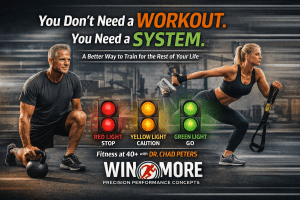
Part 2: Traffic Light Feedback 🚦
After every set, athletes self-grade the quality of their lift using a simple color system:
-
🟢 Green = Everything felt right. No pain, no breakdown, full control.
-
The athlete felt the lift worked the correct body part, in the way it was supposed to.
-
-
🟡 Yellow = Something was off. Tempo, energy, mechanics—still safe, but not sharp.
- Yellow by itself isn’t a game stopper. It’s a slow down and assess signal. String a bunch of yellows together and it’s time for a coach to step in and help.
-
🔴 Red = Pain, poor reps, or a breakdown from somewhere. Stop and reassess.
- this could be social issues, like a bad breakup. Or it could come from a lack of sleep, exhaustion, the pressure of an exam, their mind elsewhere, a sprained ankle. Red doesn’t say what. It says, investigate!
Why it works:
-
It builds real-time athlete feedback
-
It allows coaches to make quick, targeted adjustments
-
It opens the door for honest conversations about performance, stress, or fatigue
Your weight room starts sounding like this:
“4×8, all green lights. Let’s go.”
“That was a yellow. Knees collapsed on the last 2 reps, back the weight down and really real it the next set!”
“That was a red. My shoulder felt off. Something isn’t right.”
👂 Now you’re coaching. Not guessing.
Bonus: What Red Reps Really Mean
When an athlete throws a red light, it’s not always the lift.
Sometimes it’s:
-
A breakup
-
A skipped breakfast
-
A looming exam
-
A fight with mom
-
Or just a tough day
This system gives you a way to see that—and do something about it.
🧠 It’s not just better reps. It’s better relationships. It’s way to assess set by set, “Is this lift an asset or detriment to my goals? & Does it make me a better player?”
Conclusion
Auto-regulation and the traffic light system are two of the most underrated coaching tools in the weight room.
They’re simple, powerful, and teach your athletes how to train with awareness and precision.
If you’re trying to change your team by Game Day?
This is how you build smarter, safer, and more consistent progress.
Strong reps. Clear cues. Better buy-in.
Every single set.
Precision Performance Concepts
Performance is a skill. Coaching is a system. Need to dive deeper? I’ve got these ideas in detail, along with about 100 other hard hitting topics built specifically for coaches right here!
https://books.by/precision-performance-concepts