Here’s the information on how I treat the vast majority of my hamstring strains clinically.
Ice and contraction.
Not:?Stretch and Heat
there are many different types and degrees of hamstring strain and injury.?This article serves as general purpose intel only.?A proper examination makes a big difference in outcomes.
And here’s why…
We’ve all been there. A pulled hamstring doing a sporting event.
It could be that you were running fast and just stepped wrong.
It could be that your football player just got hit at an inopportune time.
Or a basketball player that went Sky High for a rebound and landed wrong.
Perhaps you pulled a “hammy” in New Year’s resolution setback from the gym.
Despite the mechanism, nearly everybody will strain a hamstring or come up with a pulled Hammy at some point.
The information on how you want to treat this particular injury has dramatically changed since the early 2000s.
Let me share.
If you are old enough, I want you to think back to the Olympics from the generation before. it was almost like clockwork, in the 100 m semi-finals you would see some poor guy or girl pull up with a strained hamstring while competing for their country.
It happened every time.
A trainer would go out onto the track, lay the Sprinter on their back, and immediately start stretching the hamstring, a la’ the ole’ “catapult technique.”
One leg on the ground, the other stretched perpendicularly, to the point of pain or close.
You can Create this yourself while stretching in the doorway. Something TikTok and Instagram can show you with a surprising number of videos set to catchy background beats.
But this isn’t the last generation. Like everything, information has become abundant, but Intel and technique changes are hard to come by.?Hopefully, that’s why you came to this page.
You simply don’t see athletic trainers running out onto the field to stretch hamstrings in the 100m or on football fields anymore. True, you’ll see it for cramping issues but you don’t see it for pulled hamstrings very much.
Do you know why?
Because – It’s a bad idea, and athletic trainers are fantastic at modern treatment protocols.
Well, they should be.
Despite their knowledge base and specialization, about 80% of ALL practitioners are doing what they were taught.?What WE were taught was the best for OUR time, but, like all fields, change happens fast, and what we were all taught is most likely already outdated or changing.
That’s just the speed of healthcare information.
I once heard one of my favorite podcasters say that even as a cancer specialist focusing on the liver, about 40% of what they learned while in school had already changed by the time they learned it!
And a pulled hamstring is nothing as serious as an oncologist deals with.
I’m going to share the idea of a “fast stretch” injury with you.
In my clinic, I use an Ace bandage to teach patients, staff and interns. It’s simple and displays fibers that make for an easy analogy to the hamstring.
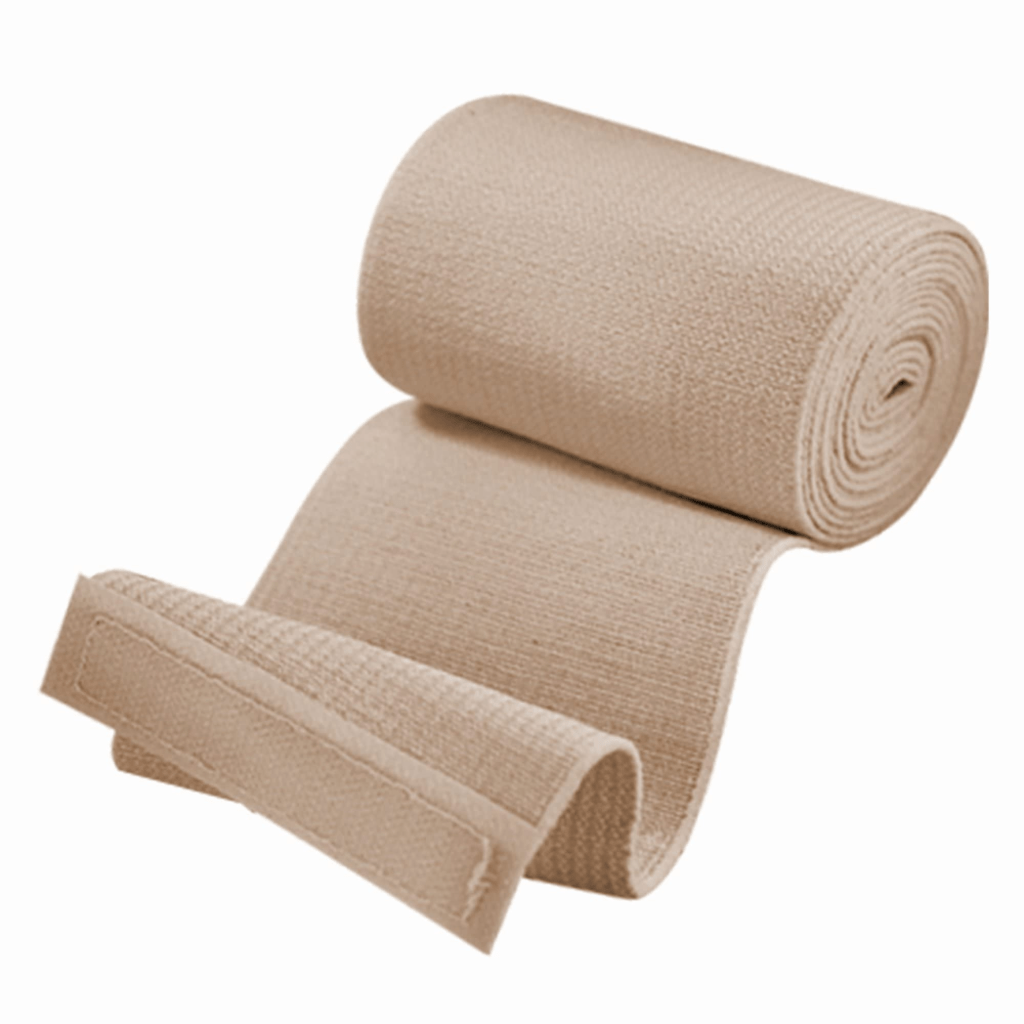
In most hamstring injuries, the muscles are strained with what is called a long stretch or a fast stretch. The stretch is what causes the small tears; it’s what makes up the injury.

Note the torn fibers in the old damaged Ace bandage. It’s a fair analogy and solid mental picture of a muscle strain.
There’s also an inflammation component for a new injury.
And while blood does carry the components of healing, for most acute injuries, the brain sees extra blood accumulation as increased inflammation and gets the signal, “Something has happened that has made this injury even more inflamed than it was just 10 minutes ago. We need to lock down this area so further damage doesn’t occur.”
That explains tight muscle, inflammation, muscle tear, and why techniques have radically changed.
Modern treatment for most hamstring injuries now starts with low-level contractions and ice, not stretching. Not heat.
You want to stop the inflammation initially to signal to the brain that things are better. That stops the lockdown and the loop of continual contraction.
When you have an athlete stuck in a contraction Loop and are a practitioner that uses their hands (palpation) as a gigantic part of their diagnosis ( chiropractors, physios, Athletic trainers, and PTs), It’s easy to miss this step.
It’s easy to feel tight muscles and think, “We need to loosen these up and create more pliability and stretch.”
The real problem is that the information is sketchy.
The tight muscle isn’t the injury. It’s the response.
For nearly all of the hamstring injuries I have seen in over two decades of work, the injury is muscle strain. Think of a run in the ace bandage (pictured above) or a “run” in pair of socks. The tightness is usually an elongation and, in fact, is a protection from a fast stretch injury.
Note: Over the last decade, one or two research studies have demonstrated that ice was not a critical component in the healing of muscle, tendon, and ligament injuries.?Hence, this leading to a decreased use of ice as a treatment modality and the use of heat and “cupping for hickeys” for blood acceleration.
A similar thing happened with the Electric Stim. machines.?I love research studies.?They give direction to my protocols.?However, in my setting, I need what works and what works faster, better, and more efficiently, and EMS and ice are much better protocols for the majority of these “tight muscle response injuries.”?It just took me some time to figure out “WHY?”
When I present my treatments, these research studies are often thrown back at me, “ proving” how my ideas are wrong and that heat needs to be the primary treatment modality.
My answer is this:
“I have never once believed that ice penetrates deep enough to affect the injury. Ice stimulates your skin and gives your brain a much larger area of stimulation. (Body mapping) The skin has more nerve endings specifically for pain and touch than deep muscle fibers. By giving the skin more information, you are giving the brain better, less pixelated, more detailed information.”
Basically, you’re letting the brain better judge how severe the injury is based on skin stimulation.
Much of the research I use clinically, with better success, is conducted by The Rock Tape company and is done by research-based athletic trainers. It’s modern, detailed information that is very Cutting Edge but, even more importantly, has a significant impact on the reduction time of these injuries at boots-on-the-ground clinics like mine.
What I’m saying is the athlete gets better faster.
That’s why I love ice. Not because my PE teachers from the ’80s and ’90s told me to ice but because modern information shows that skin stimulation helps create better body mapping through neurology. Better Body mapping allows for better assessment of the injury and better treatment with faster recovery.
Like many things in sports med, “It works, it’s just working through an entirely different mechanism than we thought it was.”
I’ve got to warn you, though, when I explain that it is a baited hook.
I can’t wait for someone to ask, “If you’re doing it strictly for skin stimulation, then why not just use Heat?”
That’s a great question.
The answer is that the heat brings more blood to the area, which the brain interprets as more inflammation and further interprets as a more significant injury.
The brain is going to do what it does to protect the body. Lock that thing down, and that creates a contraction Loop.
I can get more in-depth on this, but I probably have about a dozen articles on this website already.
There is a very easy test you can do utilizing hip mobility and rotation to better understand whether the hamstring and glute, which typically work together in sports, are tight because they are too short or too long. I can tell you that as we have been checking this in nearly every patient that has come into my door for the last decade or so, 95% of them have “too long” hamstrings. Overstretched and hence “tight,” although not in the classic sense.
Flex your bicep and feel it. Pretty tight, huh? Nice work.
Imagine hanging from a pull-up bar. Your biceps are also “tight” despite being extremely stretched.
From palpation alone (feel and touch), tight muscles don’t give me much information.
The natural step is figuring out which version of tight they have and applying the appropriate treatment.
Get modern. Get healthy.
For most hamstring issues, contraction, especially using your hand to feel it shorten (biofeedback loop), and ice seem to work much faster than stretching and Heat, especially in the initial treatment or if what you are doing isn’t working.