Why the offseason plan that looks right can quietly steal what makes a running back special
a PPC LAB STORY
Sports performance ideas based on real cases
Dr. Chad Peters
THE SEASON THAT PUT HIM ON THE MAP
TRE had a fantastic junior year.
Not hype-driven.
Not label-driven.
Just undeniable on film.
He was the modern running back coaches love.
Slot hybrid.
Caught passes.
Scored in space.
Finished runs.
Handled goal-line work.
Stayed on the field.
His team played 14 games, pushing into the third round of the playoffs. By the end, TRE was sore, banged up, and worn down, but productive.
That part felt normal.
What didn’t feel normal was the offseason.
TRE expected the bounce back.
The light legs.
That spring you feel when the season finally lets go.
Instead, a few weeks into training, everything felt… heavy.
THE IDEA THAT MADE SENSE (BUT WAS WRONG)
TRE weighed about 200 pounds.
Like most good football players, he did the math the way football had taught athletes to think for decades.
If I’m this good at 200, I’ll be better at 220.
There wasn’t pressure.
His dad was excited.
His coaches were excited.
Colleges were starting to follow him on social media.
Summer camps were stacked on the calendar.
TRE was hungry.
AND he went to work.
WHAT HAPPENS WHEN MASS BECOMES THE GOAL
The scale moved.
Of course he got stronger, his lifts went up, and he looked more like what people expect a college running back to look like.
But something subtle happened.
His first step felt slower.
Cuts felt wider.
The bounce didn’t come back.
Nothing was broken.
But he wasn’t better.
THE UNLIKELY INTERRUPTION
The shift didn’t come from a coach.
Or a trainer.
Or a parent.
It came from a kinesiology class.
55 minutes, 4th period.
One whiteboard.
One teacher who happened to be… different.
THE WHITEBOARD MOMENT
The teacher capped the marker.
“Before anyone jumps in,” he said,
“the 40-yard dash isn’t pure acceleration.”
A few heads nodded.
“But,” he added,
“it is the most common speed metric football uses.
So we’ll use it to keep this simple.”
He then turned the whiteboard over for the class to see.
“Think of this like building the same athlete
in a video game.”
“Same genetics.
Same skill set.
Just different selected POWERS.”
Then he wrote at the top of the board:
SPORTS PHYSICS
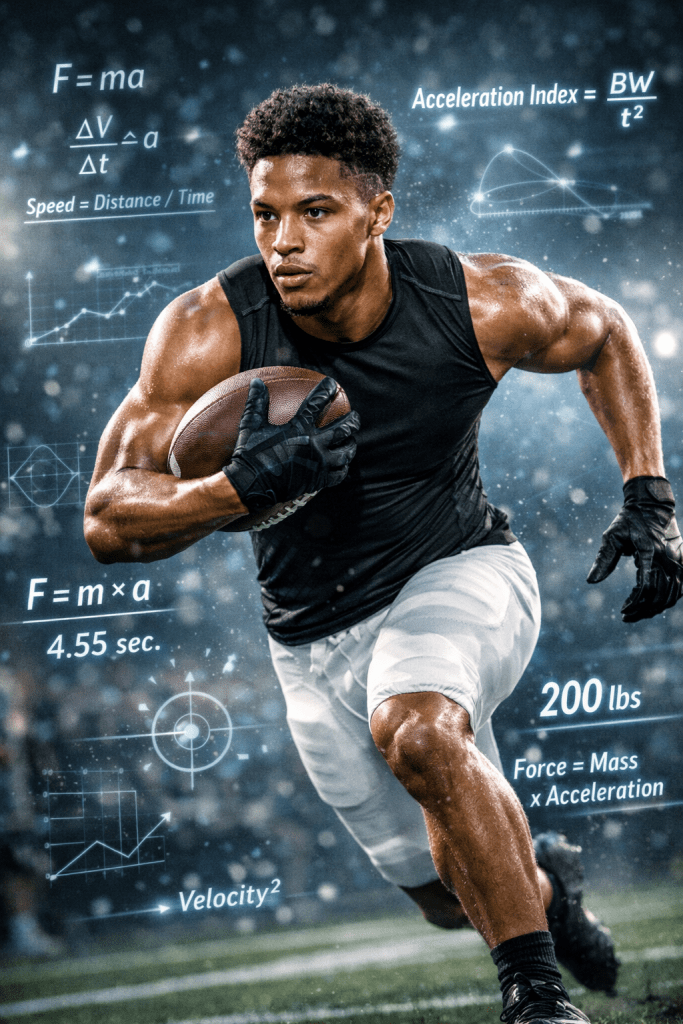
Acceleration Index (relative) = Bodyweight × (1 ÷ time²)
He underlined the equation.
“A faster time is better.
But because time gets smaller when you’re faster,
we flip it. Don’t worry about the math, but you all understand that?”
He tapped the board.
“That means a higher score equals more usable force.”
Then he explained the same athlete built four different ways.
ATHLETE A — BASELINE
(Solid, explosive running back)
200 lbs @ 4.70
= 9.05 relative units
“This is our starting point,” he said.
“A Really gifted and good player.”
ATHLETE B — MASS CHASE
(Gained 20 pounds in the offseason)
220 lbs @ 4.80
= 9.55 relative units
“This is the version most people aim for,” he said.
“More size. More mass. Higher score. this guy HITS harder, with more force.”
ATHLETE C — SAME WEIGHT, FASTER
(No weight gain, but improved speed)
200 lbs @ 4.55
= 9.66 relative units
“This,” he said, tapping the number,
“is where the equation starts telling a different story.”
ATHLETE D — LEANER AND FASTER
(Lost a few pounds unintentionally)
196 lbs @ 4.55
= 9.47 relative units
He stepped back.
“Whoops, this guy lost mass,” he said.
“But I wanted to share it for a very specific teaching point.”
WHY FOOTBALL FELL IN LOVE WITH MASS
The teacher pointed back to Athlete B.
“This is why mass was always valued in football.”
More weight, A bigger-looking number, A powerful build.
“And to be fair,” he said,
“It worked, especially back when football guys started getting bigger in the 1980’s and 90s. You could see the success it brought.”
WHAT THE COMPARISON ACTUALLY SHOWS
Then he pointed to Athlete C.
“But look what happens when you don’t gain weight and just get faster.”
Same athlete.
Same frame.
More usable force.
Acceleration wasn’t just important.
It was dominant. This is how sports and training for sports is changing and WHY.
THE PART THAT CHANGES HOW YOU THINK
Finally, he pointed to Athlete D.
“Here’s the one that trips people.”
“Even when an athlete loses a little mass but gets faster, he’s still right there.”
He tapped the board.
“That athlete didn’t lose performance.
He lost non-essential mass.”
TRE leaned back in his chair.
This wasn’t anti-strength or anti-size.
It was pro-efficiency.
WHERE THIS IDEA CAME FROM
“This isn’t new,” the teacher said.
He wrote a name.
Ryan Flaherty.
“About twenty years ago, Flaherty introduced something called the
Force Factor.”
Strength ÷ Bodyweight
“That ratio predicted speed better than people expected,” he said.
“And it correlated with a lot of other performance outcomes.”
“Flaherty got pretty famous. He worked on all kinds of pro athletes and Olympians. And Oh yeah, then signed contracts with the NFL and team NIKE!”
“A lot of people consider him one of the fathers of modern sports performance.”
WHEN THE STORY PICKED BACK UP
TRE didn’t leave class confused.
He left curious.
He met with his coaches.
One of them just happened to be that kinesiology teacher.
Together, they built a tailored system for him.
THE OFFSEASON THAT FELT WRONG
TRE still lifted. But less.
He still squatted and deadlifted.
Just not obsessively.
The focus shifted.
Movement.
Acceleration.
Deceleration.
Elastic work.
Change of direction.
Some days the workouts looked… easy.
A few lines on paper.
Sessions that didn’t leave him wrecked.
And yet.
TRE kept getting stronger.
His body changed, even though the scale didn’t.
He looked more athletic.
WHEN SPRING ARRIVED
By the time spring ball came around, TRE was sold.
Not because of numbers.
Because of how he felt.
Then track season hit and it really clicked.
The sprint work.
The mechanics.
The efficiency.
It didn’t just help track.
It amplified athleticism.
THE OUTCOME
TRE didn’t just improve.
He blew past his junior year.
Faster.
Healthier.
More explosive.
More consistent.
The conversations with colleges changed.
Then one turned into a scholarship.
THE FULL-CIRCLE MOMENT
TRE didn’t just accept the offer to go play. He chose a major.
Sports Performance.
The same field that changed his offseason.
The same science that corrected an old belief.
The same ideas that helped him unlock more of what he already had.
THE PPC LAB TAKEAWAY
No matter what TRE did,
he was going to be pretty good.
But there are advantages to focusing on the right performance parameters.
And it isn’t just size and strength anymore.