You’re ramping up mileage.
Track (football, soccer dance…you name it) season just started.
You feel that dull, burning pain down the front or inside of your shin — and you’re hoping it’ll go away.
Bad news: Hope is a terrible treatment plan.
Good news: There’s a better way forward, and it starts with actually understanding what’s going on.
💥 First: “Shin Splints” Is a Garbage Term
Let’s be clear:
“Shin splints” doesn’t describe a diagnosis — it just describes a location of pain.
The term is basically shorthand for, “My shin hurts when I run.”
But there are easily 20+ different causes of pain in that region, ranging from muscle overload to full-blown stress fractures.
🧠 What’s Actually Happening?
In most cases, what you’re feeling is a condition called:
Anterior Tibial Stress Syndrome (ATSS)
This is a stress response, not an isolated injury. The bone, the soft tissue, and the surrounding fascia are overloaded — usually from ramping up too fast, too soon.
It’s not a weakness. It’s not bad form.
It’s usually a ratio issue between the bigger posterior muscles and the smaller, underprepared ones in the front.
📉 The Front-Back Mismatch
Think of your shin as a tug-of-war between:
-
The calf muscles in the back (big, strong, built for power)
-
And the tibialis anterior group in the front (small, stabilizing, often undertrained)
As you run more:
-
The posterior chain adapts quickly
-
The anterior chain falls behind
-
Tension builds where those smaller muscles attach to the bone
-
And eventually, the system starts to scream
🩻 What the Workup Should Actually Look Like
This is where a trained eye — and hands — matter.
🔍 What We Check in the Clinic:
-
Palpation: Is the pain soft-tissue or bony? Localized or diffuse?
-
Movement screen: What’s the foot doing during gait? How mobile is the ankle?
-
Muscle test: Can the anterior tibialis hold under load? Can the foot stabilize under fatigue?
🛠️ Chiropractic Adjustments
All of these muscles attach to different segments of the foot and ankle.
If those bones aren’t moving — talus, navicular, cuboid, calcaneus — the tissues above have to overwork.
Adjusting this region (one of the body’s three major engines) can make a massive difference in restoring proper motion and offloading stress.
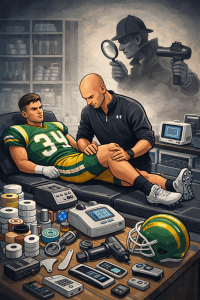
🧰 Treatment Tools That Actually Work
This isn’t about doing everything.
It’s about choosing the right thing.
✅ Voodoo Bands
-
Wrapped in a spiral/helix pattern, they can reset tissue behavior and provide pain relief
-
But not everyone benefits — for some, any compression makes it worse

✅ Decompression Work
-
Think cupping with long fascial glide, not static suction marks
-
This technique can relieve pressure on cutaneous nerves just beneath the skin
✅ RockTape or Kinesio Tape
-
When applied properly, it can enhance proprioception and reduce surface tension
-
Often used when decompression is needed without hands-on care
But don’t get cute with it.

We’re in an amazing era of recovery tools, but more doesn’t mean better.
I still see runners at races with both RockTape AND compression sleeves on the same leg — one telling the brain “we’re tight and compressed,” the other saying “we’re lifted and loose.”
That’s not therapy — that’s lower leg dyslexia.
💪 The Real Fix: Strength and Rebalance
You don’t stretch your way out of this.
You reset the ratios and re-train your system.
Start here:
-
Heel walks (toes up)
-
Resisted dorsiflexion
-
Toe lifts + short foot activation
-
Glute engagement drills + ankle mobility
-
Chiropractic to reset structure + motor control work to lock it in
Also, tweak the workload:
-
Softer surface
-
Shorter stride
-
Lower frequency
-
More feedback, less volume
🧬 Final Takeaway
You’re not broken.
You don’t need to quit.
You don’t need five different sleeves and gadgets stuck to your leg.
What you need is clarity.
-
Clear diagnosis
-
Strategic treatment
-
Smart load management
-
And a system that can adapt to what you’re asking it to do
It’s the future. Understanding and treatment have changed significantly. This entire website is built to keep you modern.
Let’s stop chasing shin pain with guesswork.
Let’s fix the right thing — and get you back on track.