

Outdated injury protocols are holding back you back as an athlete after an injury.
If as a staff, you’re not using this – it’s holding your team back.
Here’s a proven, easy-to-implement framework that helps athletes recover faster and return stronger.
Injuries are inevitable in sports. But how do we handle them? That makes all the difference.
Most return-to-play protocols are outdated, vague, or overly cautious. The result: missed playing time, preventable re-injury, and frustrated athletes, coaches, and parents.
It doesn’t have to be this way.
This article lays out a smarter, step-based system that puts the athlete at the center and gets everyone working together.
Wait a few weeks. Try again. Hope for the best.
“I’ve rested for a couple of weeks, I feel good. I think tomorrow I’ll start off right where I was before I got hurt.”
Time-based clearance only.
Zero feedback, zero progression.
“Oh, that injury? Yeah. That takes six weeks to get better..”
This system is by far the most common in all of our industries (sports med outside of the school) and is wrong for so many reasons.
It builds mistrust and encourages players to hide injuries or go outside the system.
They rely on time, not tissue tolerance, progressive loading, feedback, testing or plan. There is no room to modulate, no pivots to take with good or bad days. They’re overly black and white. Dated.
They force athletes and coaches into an “either/or” box. They create an adversarial dynamic: athletes vs. trainers, parents vs. school policy.
The athletic trainers, athletes, coaches, administrators, doctors, chiropractors, physical therapists, and anyone involved with this athlete needs to be on the same page.
And the reality is, that’s a nearly impossible task.
It’s hard enough to schedule a lunch get-together.
The reality of 15 people all getting together to exactly and perfectly help a junior varsity wide receiver, with the realities of our busy lives outside of sports just isn’t very feasible.
Add to that, that schools need to have liability protection. There’s just real-life bureaucracy that is part of the system and to ignore it is to have your head in the clouds..
So it doesn’t have to be a perfect plan.
What we need is a better plan!
Here’s how we do it better.
Return to Play: A Smarter Protocol for Safer Comebacks
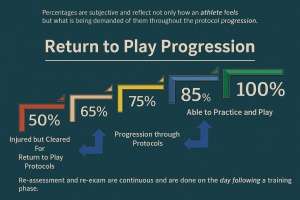
Once the athlete has been treated for the acute injury and is ready to begin a return to play.
Day One: 50% — and Nothing More
The first day back should feel ridiculously easy. That’s the point.
If you’re typically a six-minute mile runner, 50% effort means running closer to a nine-minute mile. That’s your ceiling. No pushing, no testing limits. Just one mile. Then stop.
And yes — I know you’ll feel like you could’ve done more. That’s how we want this! But we don’t make return-to-play decisions based on how you feel during the workout. We make them the next morning based on how your body responds.
*If an athlete cannot perform at 50% they have no business being at any practice. They are still injured and should be treated in the INJURY stage!”
If that light session causes pain, then you’re not ready. You’re still injured. No shame in that — it’s just information.
But if 50% truly felt easy and your recovery is smooth, you’ve earned the right to progress.
Step Two: 65% Effort — But What Does That Look Like?
This is where the art meets the science. What does 65% look like for your sport?
For the track athlete, maybe it’s an 8:30 pace for 1.25 miles.
For a football player recovering from a shoulder injury, it’s certainly not the Oklahoma Drill or a full defensive line session.
It’s not about babying — it’s about smart loading.
Athletes, coaches, and athletic trainers all need to be close as to what 65% session looks like. After the session, we wait again.
The next morning tells us whether we move forward, stay steady, or step back.
If you need to stay at 65% for a week? That’s not a failure — that’s rehab.
The Progression Ladder: 75%, 85%, 95%
As you progress, the workload increases — but so does the importance of feedback and adaptation. If you hit 85% and it doesn’t feel right? Drop back to 75%. This isn’t a fixed six-day plan. It’s a flexible system with built-in safeguards.
The goal isn’t perfection — it’s durability. Readiness. Confidence. Progressing too fast is a recipe for reinjury, and we see it all the time: athletes trying to return after three weeks of doing nothing.
That’s not a plan. That’s wishful thinking.
You Don’t Need to Be 100%
Here’s the hard truth: 100% doesn’t exist in-season.
By mid-October, no football player, volleyball athlete, or cross-country runner is at 100%. That number implies perfection — and perfection isn’t realistic.
But 85% to 95%, sustained over multiple sessions? That’s return-to-play territory.
The modern model should be this:
The physician clears, but not as a “release” The clear is for “return to monitored activity.”
The coach and athletic trainer guide the actual return to competition.
They are not the same. And that’s the entire point of this protocol.
This system is simple, coach-friendly, and protective. It removes guessing and brings clarity to the most misunderstood phase in athlete development: recovery.
And I’ve heard it…
This is a very real part of my Precision Performance Contracting service. So I get feedback. often along the lines of,
That’s a valid point.
My answer is, “Not only did you get that, but you also got an actual system to build back in the demands required. This system checks the boxes as well as goes above and beyond!”
Look, this isn’t me trying to be a lawyer. I’m not and I don’t plan to be, but the real issue with and injury and lawsuit is “negligence.”
I lean to the side that not having a true and better system than a signature and time leans more toward negligence than a doctor’s note. Just sayin’
A Step-by-Step system gives actionable feedback after every session. not “I feel good.” but based on real demands and movement – easily customizable to a specific demand and sport by a expert in these exact things. It keeps coaches, athletes, trainers, and parents on the same page.
This system Respects athlete safety while still pushing progression. Most importantly, it helps to…
Q: Does the athlete need to be pain-free to start?
No—but they need to be cleared for activity and able to perform a basic 50% effort. This isn”t the day after an injury. This is the first day they have recovered from the initial threat and injury. Its not based on pain, time, etc but on experts doing their job.
*If an athlete cannot perform at 50% they have no business being at any practice. They are still injured and should be treated in the INJURY stage!”
Q: Can athletes jump steps?
Never. The system is only valuable if followed fully. No shortcuts. The entire idea is to go beyond the, “I feel good” model.
The number one reason for an injury, previous injury. There are steps we can all take to minimize this.
Q: Is this just for high school?
No. We’ve used it everywhere. Do you know who really needs this? You! Adults! My adult athletes, gym rats and Weekend Warriors are the number one offenders of bro mentality injury treatment.
7. Closing Statement / Call to Action
At Precision Performance Concepts, we’ve helped hundreds of athletes and teams implement better systems to get players back on the field safely—and sooner.
If you want to integrate this model into your school, clinic, or coaching staff’s workflow, let’s talk. I do this. If you’d like a deeper dive I’d suggest the book I just finished: