Osgood-Schlatter’s Syndrome
It’s not a disease. It’s a growing body adapting — loudly.
Let’s clear something up right away:
Osgood-Schlatter’s is not a disease.
It’s a painful, totally common, and highly treatable condition that shows up in growing athletes — especially during growth spurts and high activity.
But calling it a disease?
C’mon, man. That’s outdated medicine.
It’s not an illness. It’s not a defect. It’s not something you’re doomed to carry around like a scarlet letter on your knee for the rest of your life.
📍 What’s Actually Happening?
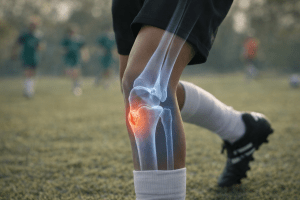
Osgood-Schlatter’s occurs when the patellar tendon (the one that runs from your kneecap down to your shin) pulls on its attachment point — the tibial tubercle — with more force than the growth plate can fully handle.
In simple terms?
The tendon is stronger than the bone at that stage of development.
So the bone responds by pulling away slightly, creating swelling, inflammation… and eventually, a visible bump.
It hurts. It’s annoying. But it’s not dangerous.
🧠 The “Disease” Problem
Let’s talk about this for a second.
Calling this a “disease” is one of my least favorite things in all of sports medicine.
Yes, I know it’s named after the doctors who studied and categorized it. I respect the research. I’m not fighting the science.
But let’s be real — disease? Really?
That word implies:
-
Chronic
-
Internal
-
Unbeatable
-
Hopeless
And none of those words apply here.
This is a mechanical overload during development — not a life sentence.
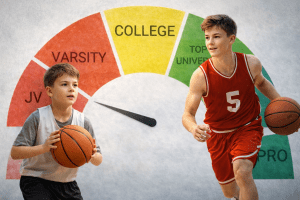
🏀 The NBA Bump Story
My own son went through this.
We treated it smart, we managed his load, we respected the pain — but more than anything, I wanted to change how he felt about it.
So we went to an NBA game.
Front row.
Why?
Because NBA games are awesome —
and because almost every player we saw had the same exact bump he did.
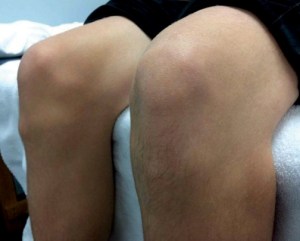
I wanted him to see with his own eyes:
That this isn’t the end.
That athletes recover.
That a bump on your shin isn’t your identity.
And it worked. That moment changed everything for him.
🧨 Severity Can Vary — Respect the Growth Plate
Now let’s not get too casual about this either.
Some Osgood-Schlatter’s cases are mild and pass in a couple weeks.
But some get severe enough that you absolutely have to shut things down.
We’re talking:
-
Major inflammation
-
Constant pain during normal walking
-
Difficulty getting upstairs
-
Sleep disruption
-
Athletes who limp even when not moving
In these cases, a complete break from sport may be needed — usually a few weeks of full rest and offloading.
Not forever. Not a lost season.
But enough time to let the area calm, reorganize, and rebuild.
The idea that you need to stop sports for an entire year? That’s usually overkill.
But pretending you can push through without consequences? That’s a mistake too.
Just like an ankle sprain comes in different grades, so does this.
It’s not one injury — it’s a category. And it shows up in multiple flavors.
The one thing I’ll say universally:
Don’t mess around with growth plate injuries.
You only get one shot to build your skeleton. Don’t skip the foundation.
🔍 What Makes This Tough
Osgood-Schlatter’s can become incredibly painful and disruptive, especially in the middle of a sports season. But here’s what you need to know:
-
The bump is not dangerous
-
The bone will eventually heal and remodel
-
The tendon will adjust
-
And the athlete will adapt
The fear and uncertainty do more damage than the condition itself.
🛠️ What Actually Helps
There’s no universal cure — but there is a smart approach:
✅ Adjust Activity, Don’t Shut It All Down
-
Avoid repetitive jumping and hard sprinting during flare-ups
-
Scale back volume — not participation — whenever possible
-
Let the athlete keep moving, just not pounding the exact tissue that’s flared
✅ Treat the Entire Chain
This isn’t just a “knee issue.”
You need to look at:
-
Quad flexibility
-
Hip control
-
Foot mechanics
-
Ankle mobility
-
Glute activation
If you’re only treating the bump, you’re missing the problem.
✅ Chiropractic + Tissue Work
The patellar tendon attaches to bones — and those bones (femur, tibia, patella) need to move well.
Light adjustments, fascial work, and targeted taping can take pressure off the site and improve the way force travels through the leg.
✅ Language Matters
Stop telling kids they have a disease.
Start explaining what’s actually happening.
If you’re a parent, coach, or provider — your words shape the athlete’s self-image. Use them wisely.
🧬 Final Takeaway
That bump? That pain? That flare-up?
It’s the sign of a body trying to grow and perform at the same time.
And that doesn’t make you broken.
It makes you human.
It’s the future. Understanding and treatment have changed significantly. This entire website is built to keep you modern.
Treat the body with respect.
Talk to the athlete like a human.
And stop calling it growing pains or a disease.