Precision Performance Concepts
Dr. Chad Peters
Why In-Season Training Needs a Different Standard
In-season training for high school soccer players is often misunderstood.
Most programs try to:
-
Maintain strength
-
Avoid soreness
-
“Get a little work in”
A fourth goal is often added:
-
Conditioning outside of regular practice time
That is not what we want to do.
In soccer, conditioning is already built in:
-
Practices
-
Small-sided games
-
Tactical drills
-
Matches
Modern Performance ideas, especially with soccer leans toward, Players do not need extra conditioning layered on top of their load. The game itself has plenty of slow burn conditioning, adding more steals the athleticism you are looking for.
These workouts are not meant to be conditioning.
They are meant to support speed, sharpness, and readiness.
Once a session veers into conditioning:
-
Speed quality drops
-
Neurology shuts down
-
The session competes with practice instead of complementing it
That approach misses the point.
In-season training should not feel like survival.
It should feel excitatory, amplifying the athlete so they leave the session better than when they arrived.
The Central Goal: Preserve and Increase Speed
Speed and acceleration in all directions is what wins in soccer.
Acceleration, deceleration, re-acceleration, and elastic response decide:
-
First steps
-
Recovery runs
-
Separation
-
Late-game performance
This system is designed to preserve and even increase speed throughout the season, not simply hold on to it.
As true speed development is added consistently, specially neurological speed work, players should get faster as the season progresses, not slower or flat.
A Key Framework: Levels Matter
Every athlete operates at a level each day

There is a level for:
-
Half effort
-
Going through the motions
-
Rushed warm-ups
-
“Good enough”
That level exists.
It’s JV.
The same exercises, performed with different intent, do not produce the same outcome.
This matters most in speed training.
There is no such thing as “kind-of fast” training.
The Non-Negotiable Rule: No Fatigue Allowed
In-season sessions must follow one rule:
No fatigue allowed.
These workouts should feel:
-
Sharp
-
Alert
-
Energized
-
Excitatory
If an athlete leaves tired, the session missed the point.
Fatigue shuts down the nervous system.
Speed is neurological.
Once fatigue enters the room:
-
Speed quality drops
-
Elasticity disappears
-
The session becomes conditioning
Conditioning already happens in practice and games.
Mobility First (Not Flexibility)
Every session starts with mobility, not stretching.
Mobility is:
-
Active
-
Controlled
-
Sport-specific
-
Immediately usable
Focus areas:
-
Ankles
-
Hips
-
Shoulders
This prepares the body to express speed, not just feel loose.
Time: 6–10 minutes
Speed Prep + Atomic Work Is the Priority
This is the most important part of the entire session.
It is not a warm-up.
It is not filler.
It is not conditioning.
This block:
-
Is purely neurological and should be done daily, if not in a separate workout session – prior to practice.
-
Requires full intent
-
Often looks like more rest than work
That is by design.
If speed work is done at 85 percent:
-
It becomes a dynamic warm-up
-
Slightly better than nothing
-
Still JV-level training
Speed and atomic work must be full tilt.
Time: ~10 minutes
Strength Training: EMOM for In-Season Control
EMOM (Every Minute on the Minute) is ideal in-season because it allows:
-
Full team participation
-
Auto-regulation
-
Clean movement
-
No grinders
Each athlete:
-
Grabs one dumbbell or kettlebell
-
Chooses load based on feel
-
Adjusts within the structure
Auto-regulation is simple:
-
Feeling great? Increase load on the last 2–3 rounds
-
Feeling beat up? Stay light and move clean
Everyone finishes together.
No one is exposed.
No one overreaches.
EMOM Structure
-
2–3 EMOM blocks
-
10 minutes each
-
2–3 minutes rest between rounds
-
Coaching and energy matter here
Target:
-
30–40 seconds of work (each player will set their own pace)
-
20 seconds of rest (what is left when you finish the prescribed reps)
This supports speed instead of stealing from it.
Sample EMOM Menu (Pick and Choose)
Lower + Shoulder
-
Weighted split lunges
(3 front + 3 back each leg) -
Halos
Total Body
-
4 burpees
-
4 split squats
-
4 overhead press
Lateral Focus
-
4 lateral lunges
-
Around-the-worlds
Tendon + Balance
-
Lateral stops and balance holds
-
bicep curls
Single-Leg Control
-
Single-leg RDL
-
Shoulder raise or row
Pull + Ground Control
-
Alternating rows
-
Get-ups
Simple Conditioning Option (Use Sparingly)
-
5 burpees EMOM
These templates are intentionally flexible and easy to modify based on:
-
Position
-
Injury history
-
Individual weaknesses
-
This system is also easily adaptable to isometrics, – holding a position for 40 seconds with 20 seconds off.
Let’s say you wanted to have a left foot forward lunge.
Hold it for 40 seconds / 20 seconds off. The next rep you will do right foot forward.
This is fantastic for tendon and ligament strength, resilience and tissue tension and although it won’t feel like a workout to the athlete – for a soccer player, basketball player in-season athlete, whose primary objective is changes of position and reaction. Isometrics are a Fantastic Exercise to use
Full team EMOM Systems also easily allows individualized training inside a team environment.
(example: “Hey, Allie, I want you doing this exercise instead this block.”)
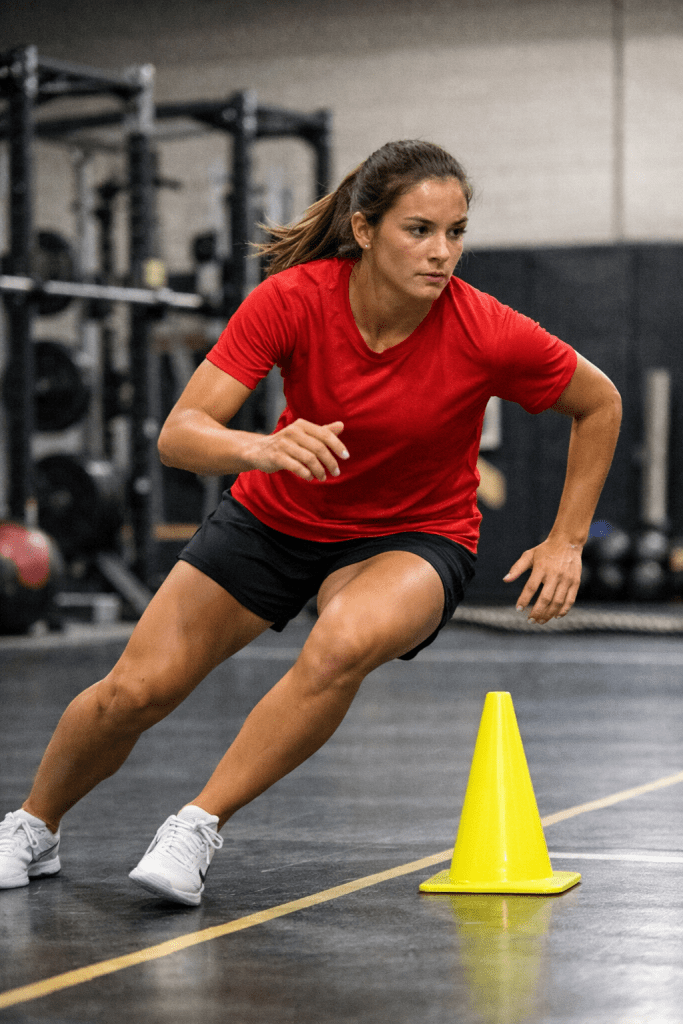
Speed Is More Than the Weight Room
Speed development in soccer does not have to live entirely in the weight room.
Acceleration, deceleration, and change-of-direction drills:
-
Pro-agility variations
-
Deceleration stops
-
Cut-and-go patterns
-
Short-burst directional drills
These can and should be built directly into the session.
Do not feel like:
-
If you’re not lifting, you’re missing the mark
In soccer, deceleration and change of direction may be the biggest difference-makers.
These drills:
-
Do not fit EMOM – these are separate workouts
-
Require short, fast bursts
-
Need more rest between reps
That’s normal.
In a 10-15 min. block, you can easily fit three to four high-quality drills.
There will be:
-
A lot of downtime
-
A lot of waiting
That is not laziness.
That is speed training.
The Effort Standard
Because there is so much rest, effort must be absolute when it’s time to go.
If I see:
-
Slacking during speed work
-
Half effort during explosive drills
I assume that’s how you play on the field.
The standard carries over.
Speed work demands:
-
100 percent intent
-
No drifting
-
No casual reps
That’s how athletes leave the session energized not drained.
What This System Produces
When done correctly, this approach:
-
Preserves and increases speed in-season
-
Protects joints and tendons
-
Avoids cumulative fatigue
-
Keeps athletes mentally sharp
-
Complements practice instead of competing with it
Most importantly, athletes leave sessions feeling better, not worn down.
Final Coaching Note
This system only works if the standard is clear.
-
Speed work must be full intent
-
Atomic work must be respected
-
Fatigue must be avoided
If that energy can’t come from in-house yet, bring me in.
I’ll model exactly what this block should sound like, feel like, and demand.
Once athletes experience it done correctly, the standard sticks.