Why Acute Pain Often Involves More Than One Area — and Why Fixing It Can Happen Faster Than You Think
Low back pain that comes on suddenly is one of the most common reasons people walk into our clinic.
Sometimes it started after lifting.
Sometimes after sitting too long.
Sometimes it feels like it came out of nowhere.
What surprises many people is that even acute pain is rarely caused by just one structure.
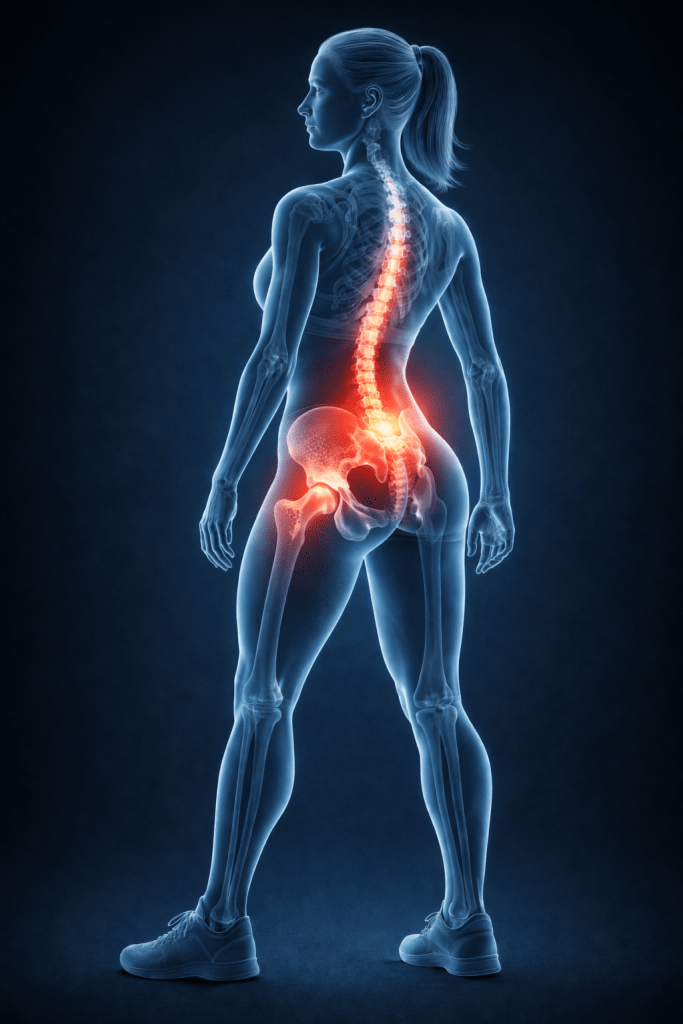
One of the most common patterns we see, especially in active adults, is a combined hip and low back issue.
These two areas are designed to work together.
When one isn’t doing its job properly, the other absorbs the stress, and pain shows up quickly.
This article explains why that happens, why it’s often misinterpreted as “one thing,” and how addressing the full system usually leads to faster results, not slower ones.
WHY WE’RE CONDITIONED TO LOOK FOR “THE ONE PROBLEM”
Most people come in expecting a single diagnosis: as in, “If I can just find whatever it is causing this pain, I’ll be so much better.”
– a muscle spasm – an SI joint issue – a disc problem – a nerve irritation
That expectation isn’t your fault, it’s how the medical system is structured.
Even as doctors and therapists we’re taught to – Name the problem. Match it to a treatment. Repeat.
Those labels can be useful for communication and even while learning at school, but they don’t always explain:
why the pain showed up
why it keeps returning or
why one approach hasn’t fully solved the problem.
I also think this is why the standard of care for so many issues is 3x/week for 6 weeks! Not because the issue is severe or that you are only feeling “the tip of the iceberg.” but more so because the practitioners aren’t addressing the whole issue but only a part.
The body doesn’t operate as isolated parts.
It operates as connected systems that share load and responsibility.
EVEN ACUTE PAIN CAN STILL BE A COMBINATION ISSUE
This isn’t just a chronic-pain concept.
Even when pain is recent or sudden, it’s often the result of multiple systems interacting at once:
A hip that isn’t moving or controlling motion well, a lower back that’s forced to compensate, connective tissues absorbing more stress than they’re designed for –
When the system gets overloaded, pain appears — sometimes immediately.
That doesn’t mean something is seriously wrong.
It means the system exceeded its tolerance.
HOW THE HIP AND LOW BACK SHARE THE WORK
Your hip is meant to be mobile and powerful.
Your lower back is meant to be stable, load bearing and efficient.
When the hip doesn’t move or control motion properly, the lower back starts doing more than its share. That extra demand doesn’t cause instant damage — it creates irritation in:
muscles and tendons, joint capsules, disc fibers, and surrounding connective tissue
Pain is the signal that the system needs help, not that one joint is “out.”
IT’S RARELY JUST A NERVE OR A SINGLE LABEL
I am asked every single day in my clinic, “Do you think this is a muscle, is it a joint, could it be a pinched nerve?” as in, either/or.
It’s all the above.
Yes, Nerves from the lower back travel into the hip and leg.
And yes, nerve irritation can be part of the picture.
But in most acute cases, it’s not as simple as:
“It’s a pinched nerve and if we fix this, everything goes away.”
There are clear tests to determine whether pain is:
primarily nerve-driven, mechanical in the hip, mechanical in the back or most commonly — a combination of more than one factor!
That distinction matters, because it changes how we treat it.
WHY WE DON’T RELY ON ONE TECHNIQUE
This is where we differ from a more traditional chiropractic-only approach.
Adjustments can be helpful, but they are one step in a larger process.
Imagine baking a cake that had five ingredients and you were asked to make it using only flour! That one step alone usually produces about one-fifth of the possible result.
That’s not because adjustments are wrong.
It’s because the problem isn’t singular.
When five contributing factors are present and only one is addressed, improvement tends to be slower and incomplete.
That’s simply not good enough for our standards.
MORE STEPS DOES NOT MEAN SLOWER RESULTS
This is the part that often surprises patients.
Even though multiple systems are involved, when they’re addressed together, results tend to happen FASTER, often within one to two weeks.
Why?
Because instead of repeatedly calming symptoms, we’re:
Putting out the fire and alarm bells (pain/spasm, inability to move well), restoring motion where it’s missing, improving control where stability is lacking, reducing tissue overload, and allowing the body to reorganize efficiently
This approach often produces faster progress than methods that rely on frequent adjustments alone over many weeks.
It’s not about doing more visits.
It’s about doing more of the right things per visit.
THIS IS NOT ABOUT SELLING A TREATMENT PLAN
We’re not trying to lock you into care. We’re not trying to convince you that you need endless adjustments or alignments as that isn’t even the philosophy of this clinic.
Our goal is simple:
To ensure that you Understand how your body is operating and address the full system that’s contributing to pain. This will help you get back to normal function as efficiently as possible
The faster the system is restored, the sooner you don’t need us anymore.
That’s the point.
A SIMPLE COMPARISON THAT HELPS
Most neck pain has a shoulder component.
The shoulder is mobile.
The lower neck is stable.
When shoulder motion is limited, the neck takes the hit.
The hip–low back relationship follows the same rule.
Pain often shows up in the stable area because the mobile joint nearby isn’t doing its job.
THE BOTTOM LINE
Acute low back and hip pain is rarely just one thing.
It’s usually a short-term breakdown in how multiple systems are working together.
Addressing only one piece may help —but addressing the entire system usually helps faster.
That’s not chiropractic – it’s not even physiotherapy.
That’s simply understanding how the body actually works.