The injury hiding behind your ankle — and why it keeps flaring up.
This one fools a lot of people.
The athlete rolls their ankle — it swells, they limp, they ice it, and over a few weeks… they feel mostly better.
They’re walking again. Jogging. Maybe even cleared to return.
But something’s still wrong.
“It still hurts when I cut.”
“It’s not solid, feels weak and UNStable.”
“It flares up after practice.”
“I just don’t trust it.”
And that’s when you start thinking:
“Maybe it wasn’t just a sprained ankle.”
🎯 Here’s the Deal: You Might Be Dealing with a Syndesmosis Injury
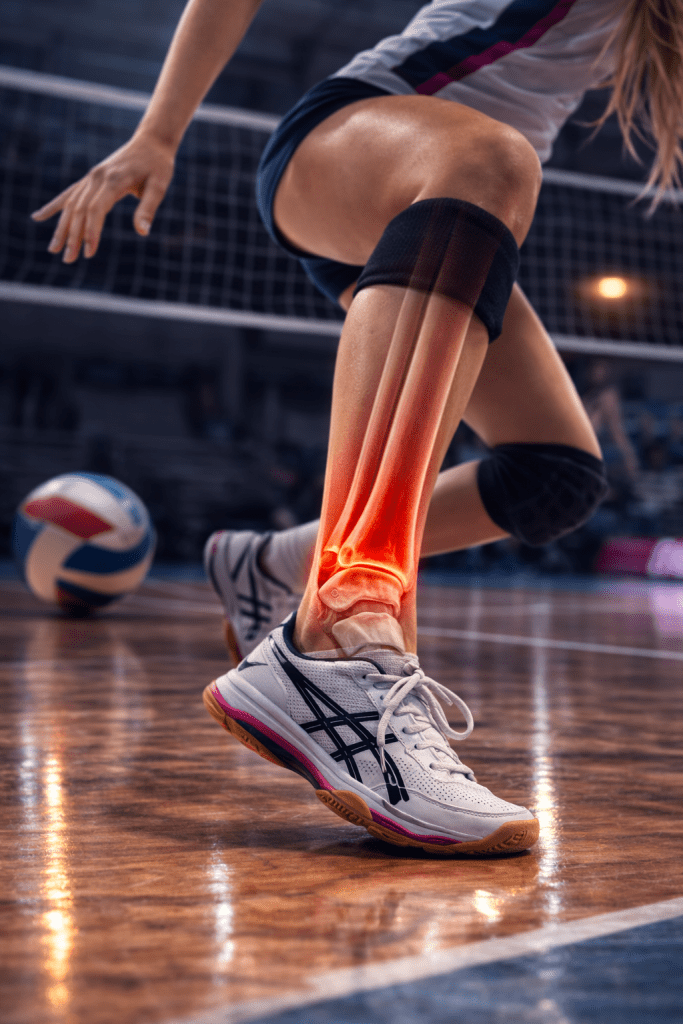
This is what we call a high ankle sprain — also known as a syndesmosis injury.
And it’s not the same as the classic lateral or medial ankle sprain you’re used to hearing about.
🧠 What Is It, Really?
A syndesmosis injury happens when the two lower leg bones — the tibia and fibula — get pulled apart slightly due to an impact, torque, or misstep.
It’s usually secondary — meaning it comes after the main ankle sprain.
But it’s the one that sticks around.
Here’s why:
Your talus (the bone between your leg and foot) is supposed to rock and glide smoothly inside the ankle joint.
When that motion gets restricted — especially after a typical sprain — the talus starts to jam upward (which most likely was the cause of the entire process.)
This keeps the tibia and fibula slightly separated with every step, which prevents the transverse ligament between them from healing completely.
And every time you try to run, jump, or cut?
That ligament gets re-irritated.
Over and over again.
📸 The Visual Breakdown
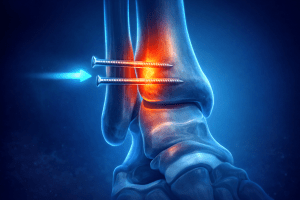
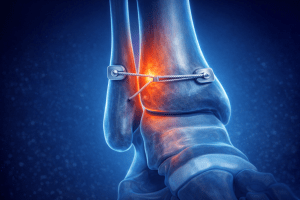
Here’s is a surgical fixation idea of a chronic and more severe syndesmosis – This is most likely why the low grade versions aren’t treated much in the western world. We just tend to look at the name itself, and “syndesmosis” tends to conjure up the more severe imagining of these issues. But, like all sprains, there are low grade versions of this, the non-surgical version is what this writeup is about. They are easily treatable.
⏳ Why It’s So Easy to Miss
Because it hides behind the “main” injury.
Your traditional ankle sprain hurts the most. It gets the ice, tape, and treatment attention.
And once that swelling goes down, everyone assumes you’re good to go.
But syndesmosis injuries are:
-
Subtle
-
Persistent
-
And frustratingly inconsistent
You feel good walking straight…
But try to pivot or push off, and it lights up again.
🧠 The Diagnostic Trap
This is where I see athletes get stuck — sometimes for weeks or even months.
Because it doesn’t show up clearly on basic imaging.
Because the pain comes and goes.
Because no one’s testing the tib-fib stability or looking at the talus movement.
And because syndesmosis is still underdiagnosed and underdiscussed, a lot of athletes just keep taping it tighter and hoping for the best.
But hope isn’t a treatment plan.
🛠️ What Actually Works
In my clinic, this is a step-by-step process:
-
Treat the primary ankle sprain first.
Don’t skip this — swelling, bruising, basic ligament integrity all come first. -
Then look deeper if pain lingers.
If it’s been 2–3 weeks and they’re still guarding… syndesmosis is now suspect #1. -
Re-establish motion at the talus.
Gentle mobilizations and adjustments can help the talus glide again — taking pressure off the ligament. -
Tape it — not to restrict, but to support.
A proper high ankle taping job can temporarily reunite the tib and fib, giving the transverse ligament a chance to finally heal that last 10%.
Most of these ligaments are already 90% healed by the time I see them — they just need that final bit of support to finish the job.
🎯 The Sports Trivia Behind It
Here’s something I see all the time:
Athletes say the ankle feels fine during games… but unstable or painful walking to class the next day.
That sounds backwards, right?
But here’s the reason why:
-
At higher levels, athletes tape or brace before games.
-
That tape compresses the syndesmosis, creating temporary support.
-
It restores the glide, holds the talus down, and masks the instability.
Then after the game?
They peel off the tape, go to class in slides or sneakers, and suddenly…
It feels like they’re walking on a roller skate.
Wobbly, untrustworthy, painful.
That’s the real-world signature of a syndesmosis injury.
It doesn’t show up during taped-up game speed — it shows up during real-life movement, when the support is gone.
💬 Why I’m So Adamant About This Injury
This one’s personal.
I suffered a syndesmosis injury in college — right at the peak of my career.
And here’s the kicker: It didn’t even hurt.
I was standing on the sidelines, ankle taped, body healthy, and yet… I couldn’t perform.
Not because of pain. But because the ankle didn’t feel stable enough to trust.
No explosion. No confidence. No presence.
I see athletes go through this exact loop — and it hits hard, because I’ve been there.
That’s why I speak up on this injury every chance I get.
It’s underdiagnosed, undertreated, and overlooked — especially in Western sports medicine.
🌏 Global Note Worth Mentioning
Of note — this injury isn’t ignored everywhere.
In countries like Japan, Korea, and China, syndesmosis taping and treatment are far more common and recognized.
You’ll see it at elite volleyball, soccer, judo, and even tennis levels.
Over there, it’s a routine injury — addressed early and directly.
Over here, we often miss it entirely… and athletes pay the price.
Why the difference? Honestly, I don’t know.
It’s simple to test.
Obvious when you understand it.
And relatively easy to fix.
But only if you know what you’re looking for.
🧬 Final Takeaway
A high ankle sprain doesn’t always scream for attention.
It lingers. It nags. And it gets missed.
But when you know what to look for, it’s clear:
If the ankle is “healed” but you still can’t cut, sprint, or trust the joint —
You’re probably dealing with a syndesmosis injury.
And that’s not just an ankle thing.
It’s a joint mechanics thing.
It’s a support and sequence thing.
It’s the future. Understanding and treatment have changed significantly. This entire website is built to keep you modern.
Don’t just tape over it and hope.
Fix it the right way — and get back to full speed.