⚽ BONUS ARTICLE
Why Kids Hesitate in Soccer (And How to Fix It Fast)
Based on the #1 most-asked question in youth soccer queries based on ChatGPT.
Dr. Chad Peters
Coaching Youth Soccer Without Losing Your Mind
You’ve Seen This All Game
The ball is sitting right there, and your player is just a step late. And in this sport, a step late equals 3-5 yards and a lame “trail and follow” of the action.
Not because they’re slow. Not because they don’t care. ‘
They just didn’t GO!
And by the time they decide to move, the moment is gone.
That’s the frustration. You feel it building all game long.
It’s Not Speed — It’s Hesitation
Most coaches assume this is a speed problem, but it’s not.
It’s hesitation.
And once you start seeing it that way, you start coaching it differently.
You’ll always have that one kid who seems to be in the right place at the right time. They win balls they shouldn’t win. They get there early. And it doesn’t always match up with who your fastest or strongest player is. But there is no doubt, they’re your best player!
What they have isn’t just quickness.
It’s anticipation. In the industry, “First step.” Not to be nerdy, but I am a sports performance guy. 1/10th of a second in soccer equals 2 feet (.6 meters) on the field!) and these hesitations are WAY more than 1/10th of a second!
Be Honest — You Can See It Too
Here’s the part that should hit you.
You already know what most kids are going to do with the ball. Parents know it. Assistant coaches know it. You might be able to tell just from watching the other team during warmups. You can see it in how they carry themselves, how they approach the ball, what they’ve done the last few touches. EVERYONE on your team should know the other team’s best layers within minutes of the start.
If everyone can see it coming, why are your players reacting after it happens?
That gap, that tiny delay – is everything in this sport.
Why Kids Hesitate
It’s not usually effort. It’s wiring.
Some kids are afraid to mess up, so they hesitate. They’d rather do nothing than make the wrong decision.
Others are bringing habits from other sports. In baseball, you wait your turn. In football, everything happens in sequence. One step leads to the next. Nearly every other sport has a cadence.
Soccer doesn’t work like that.
There are no “your turn than my turn.” There’s no pause.
If the ball is in your area, it’s yours. If someone else has it, it might still be yours—you just haven’t taken it yet.
That’s the shift most young players haven’t made.
What Hesitation Looks Like on the Field
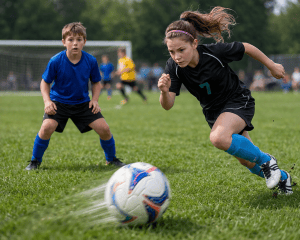
It shows up the same way every time. They wait for the ball to arrive instead of going to get it. They let the other player take the first touch. They react after the play starts instead of stepping into it.
They’re always close.
But never first.
And in soccer, that’s the difference.
Why Telling Them to “Go Faster” Doesn’t Work
We’ve all said it.
“Be aggressive.”
“Go get it.”
“Move faster.”
But that doesn’t fix hesitation, because they don’t know what they’re actually looking for. You’re asking them to speed up something they haven’t processed yet.
You don’t fix this with volume.
You fix it with clarity.
The Simple Drill That Changes This Fast
One of the best things I’ve found is something I call a freeze scrimmage. We’re playing like normal, and then I blow the whistle and stop everything.
Right there, I point to the player with the ball and ask a simple question.
“What is Mia going to do with this in the next 3 or 4 seconds?”
Now we talk it through. Does she usually dribble? Does she pass right away? What does she tend to do in this situation?
And then I say it out loud. “Every player, in every sport has “tendencies.“ If you know this, and I know this, and Mia’s uncle Joey—who shows up once every three years—knows this… what can you do to be a step ahead?”
Now you can see it start to click.
Then we flip it.
“If Mia knows her tendencies, what can she do to fake you out?”
Now both sides are thinking. Not reacting but actual thinking. Processing the sport.
We reset, blow the whistle, and go again. In freeze scrimmage, everyone gets a head start because they had time to process. In sports process starts to happen faster and more automatically with practice.
What Starts to Happen
You don’t need weeks to see a difference. Sometimes it shows up right away. Kids start moving earlier. They step into passes. They win balls they weren’t winning before. Your team “magically” learns possession.
And suddenly someone on the sideline is asking how that kid always gets there first.
“Win the ball!” “First touch!” “Be Aggressive!” It’s not speed, toughness or even understanding.
It’s anticipation.
The Real Coaching Shift
This is the part most youth coaching misses. We spend a ton of time on drills, touches, and structure, but not enough time teaching kids how to read what’s right in front of them.
When they start to understand that—even just a little—the game slows down for them. They don’t feel rushed. They don’t feel behind. They start to feel in control.
That’s where confidence shows up.
That’s where players actually improve at a higher level.
Final Thought
Hesitation kills success in this sport.
But anticipation?
That’s what makes a player look like they’re always one step ahead.
Teach this concept and reap the benefits that dozens of practices wouldn’t fix.
Want More Ideas Like This?
Dr. Chad Peters and Precision Performance Concepts have built thousands of free ideas, articles, and resources for coaches, athletes, and parents.
The goal is simple: make modern sports performance easier to understand.
That means everything from modern approaches to common sports injuries, speed and performance, recruiting and preparing for college, to understanding which metrics actually matter when the athlete steps onto the field.
If this article helped, check out Coaching Soccer Without Losing Your Mind. https://a.co/d/0hbM9mlu
The book was originally written for new coaches and parents who suddenly found themselves “volun-told” to coach a team and needed some help figuring out what actually matters.
One of the most enjoyable surprises has been hearing from experienced coaches too—from elite U18 programs through the college level—who have found useful ideas inside it.
And that’s because this isn’t really a book about soccer strategy.
It’s about the things surrounding the game that can make coaching easier and athletes better: communication, confidence, parents, anticipation, practice design, motivation, decision-making, and dozens of small coaching wins like the one you just read.
The manual is intentionally quick, direct, and useful.
Less fluff. More ideas you can actually use.
You can find Coaching Soccer Without Losing Your Mind on Amazon, and it’s also available free through Kindle Unlimited.
It also makes a pretty good gift for the coach in your life—and beats spending another evening chasing 37 different coaching ideas through social media.