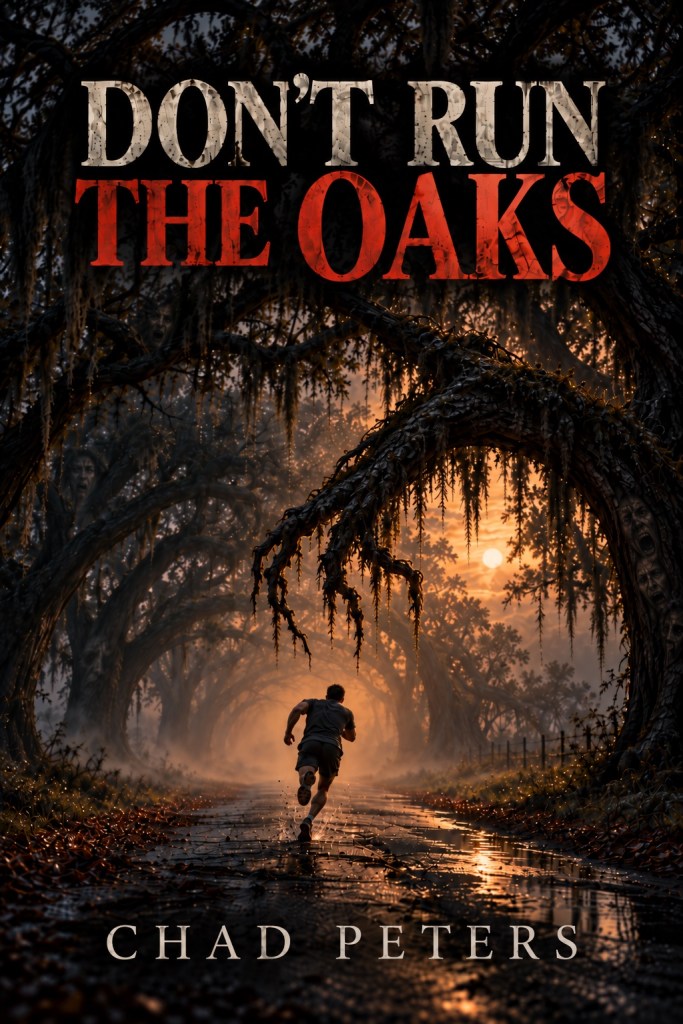
a short story by Chad Peters
I.
Back before anyone alive today was born, when Corpus Christi was more cattle town than city, a bachelor with East Coast money came to a place of wooden houses, cattle pens and saloons, where the main street still had horse posts and water troughs. He built a mansion that would have fit best in Newport, as nobody built anything that size this far south. Every stone of it had to come in by rail or by ship. Once the house was completed, he planted thousands of oaks all around it. In a city of mesquite and palm trees, he turned his two square miles into an oak forest.
The hurricane of 1919 flattened half of Corpus Christi and never touched his house. Local legend says not a single one of his trees came down.
The city grew, the way cities do. Over the years, those two square miles filled in with streets and houses like everywhere else, and somewhere along the way the area got the most obvious name it could have. The Oaks. Everybody in town knows it. “I live two blocks off The Oaks” works as a set of directions here just as easily as “off Ocean Drive, Southside or the Lakes.”
But it never quite became the rest of Corpus Christi.
Corpus Christi hums. You hear it in July when the heat pushes the horizon into a blur, and on football Fridays when every H-E-B has charcoal stacked just inside the door. At night the ships click and breathe out in the bay, and the gulls argue with each other. I have lived here long enough to know the notes. Wind on the causeway. Red Dirt Country coming from an outdoor bar, and cicadas winding up in the trees until you can barely hear yourself think.
There is one pocket of town where the hum drops out, and you already know which one.
Over time, the old carriage paths turned into streets that wind around the trees instead of cutting through them. The people who built there wanted to live in the old man’s world, not ours, so they built big houses, six thousand square feet and more, with stone hauled down from San Antonio quarries and finished with steep roofs and ironwork. Even the ones built thirty years ago were made to look a hundred years old.
Corpus is stucco and low roofs that duck under hurricanes. The Oaks looks like it belongs somewhere with winter.
The original mansion is still in there. Only, it isn’t on any of the main drives, and you’d never see more than a glimpse of it on an evening cruise. It sits back behind the others, and as far as I can tell, the only way to it is down an access alley, a narrow gap between two of the big houses that you would figure leads to somebody’s pool equipment and nothing else. I honestly can’t tell you which house is the real one. They are all gigantic, every one of them trying hard to look like old money, and the real one gets lost in the crowd. I have run past it a thousand times, and I have never been sure.
A few decades back, the neighborhood put up a gateway announcing the area. Two limestone pillars, a tasteful little fountain, and three massive boulders. At night, the sign lights up green and gold. THE OAKS, it says, as if there were any doubt about where you are.
The houses do not have real street addresses either. The place is older than the city’s numbering, so each one just has a small brass number set low beside the front walk, counting up one side of the main street and back down the other. The first house inside the gate is number one, and the last is somewhere around a hundred.
An address is as simple as that. #42 The Oaks.
The houses alone would make The Oaks worth a visit, but it’s the trees people come to see. The old man’s live oaks line both sides of every street, a hundred and twenty years old now, with trunks so wide three grown men could not link hands around them. Their limbs twist and bow and reach for one another until they meet over the street, forming a tunnel of shade and dark that swallows sound and color.
In a city of palm trees, sunlight, and hot ocean wind, The Oaks are wrong in a way that feels like a relief. Even in August, the temperature drops ten degrees under that canopy. The air smells like wet bark and old wood.
***
I am an avid runner, to the point that it’s how I describe myself. My identity. You know the type. I introduce myself at parties, quickly work it into conversation, and find others of my tribe. My small talk is trails and loops, upcoming 10Ks, running vacations, shoes, tech, and times.
I live close enough that I use the tunnel as a kind of reset. I run it because it is cooler. I bike it when the sun feels like it is drilling holes in the top of my head. On the worst days I drive it for no reason, windows cracked, just to feel the air change for a mile or so.
If you pull up my route history on my Garmin, there is a shape you’ll see over and over. The Oaks loop. The streets wrap back and forth until the GPS track looks like a bent paperclip. Two and a half, maybe three miles if I add a little tail to it. It is my default. My comfort loop.
I love my Oaks loop. But if I’m being completely honest, I have never fully trusted it, and I think that is half the draw. Any runner knows the little hit of adrenaline you get on a dark stretch of road at dusk, the part of your brain that stays on watch while your legs do the work. The Oaks gives me that every time, and it’s only a few blocks from my house.
II.
Everybody in Corpus knows the stories of the faces in The Oaks. It is one of those things the city passes down. Every family has a cool uncle or older cousin who loads the little kids into the back seat at dusk, kills the radio, and creeps the car through the tunnel at five miles an hour, pointing out the trees. “That one is the old man. That one is a little girl who never came home.” Then he hits the gas, everybody screams, and the kids beg to go again. Teenagers take dates through there for the same reason. A thrill. Nobody really believes it, and nobody is quite willing to say they don’t.
There is a name for what those kids are seeing. Matrixing. The brain is built to find patterns and faces, so it finds them everywhere, in wood grain and in the front grille of a VW, just as a kid lying in the grass finds a puppy or a turtle in the clouds. Someone explains it every October. It has never discouraged the passersby.
Around Halloween, the fun takes a more sinister turn. The stories say it becomes much more than faces during the week before and the week after, and there are two versions, depending on how old you are.
The kids’ version gets passed around every October at school, on the bus, at sleepovers with the lights off: Over the last hundred years, children have gone missing in The Oaks.
Around Halloween, their faces show up in the trees. Not the shapes your brain makes out of bark and knots the rest of the year. Real faces, pressed up behind a round scar of a healed-over limb, like somebody crowding a submarine window. It only happens at night, and typically if you are alone. Some say it has to be a full moon. Some swear the faces turn to follow you. Everybody agrees you cannot photograph them. Phones get images of bark and wood grain, maybe a smudge if you want to believe bad enough. The faces belong to the eye and nothing else.
The adults hear a longer, possibly more accurate version, one not told at sleepovers.
The reality of that time in history is that the estate ran on people. Maids and cooks. Yard men and stable hands. A man to drive the carriage, a footman to open the door, a humorless governess for the children. (There are always stories of children, even though most say the man was never married.) People whose names lived only in a ledger book. And in those years, people went missing the way they do in any young town with more land than law. A hired man who supposedly stepped in front of the wrong train. A cook who left one night and never came back for her pay. A maid who left a note saying she quit, and whose trunk was rumored to have turned up decades later, buried under the corner of a new foundation when one of the big houses went in. Nobody filed reports, and nobody came looking. The kids talk about missing children. The grown-ups know it was never just the children.
Corpus Christi does not hide from its dead. This is a Mexican city at heart, and come late October the whole town goes all in. Day of the Dead and Halloween run together into one long celebration. There is the art fair downtown, the sugar skulls and calaveras, altars with marigolds and photographs, families honoring their dead out in the open, the way you are supposed to. It is one of the best times of the year to live here.
The Oaks does not take part. The porch lights stay off. Nobody puts out a bowl. That doesn’t stop handfuls of kids from going out a little later than they should, daring each other up those long, dark walkways to bang an old copper knocker and run. They think they are playing chicken with grumpy rich people. Plenty of folks in town aren’t so sure that is who they’re playing with.
I did not grow up here. I married into this city. By the time our kids were old enough to ride bikes with their friends, I knew which streets stayed safe after dark and which ones to avoid. Somewhere along the way, without deciding to, I became the dad with a rule every October. It is small and clear. “Do not walk that tunnel alone at night the week before Halloween or the week after.” It’s the same rule as the rest of the city, only many locals say it while making the sign of the cross and murmuring about cuidado and bad ojo.
We do not say why, not in front of the kids. If they bring it up, we joke about weirdos. “Weirdos” is a fair catch-all for drunks, spring breakers and dudes in white vans offering candy and puppies. The older I get, the more I think the word is exactly right.
III.
In daylight, The Oaks reads as money. Big yards. Winding roads. Lawns that don’t heed a water restriction. But if you run that loop enough mornings, you start to notice how the weird does not announce itself. It just seeps out of the corners.
There are almost never for-sale signs. Once in a while a post sprouts in a yard, white and temporary, and if you drive past that afternoon, the sign is gone. Pending. Sold. Removed. Depends who you ask.
I have no idea why. What I can tell you is this: I don’t run this route every day, but I’ve been through it hundreds of times, and I’ve never once seen a moving van, coming or going.
Oh sure, there are people. Residents. Weirdos, maybe. Like the lady with the incredible azaleas.
I was jogging the tunnel one Sunday when I saw her. Wide-brimmed hat, long pants, hose in one hand, working the ring of azaleas planted around the base of a live oak. She stood unusually close to the trunk, barely a hand’s width from it. She watched me approach with the look people wear when they know your face from the grocery store or the sidelines but cannot place you. I gave a little wave. Runner manners.
She nodded once, like a woman coming out of a trance – just long enough to clock that I existed, then turned right back to the tree. She lifted the hose off the flowers and aimed it directly at the bark. Water slapped against the trunk and splashed straight back into her face, down her chest and over her clothes. She didn’t flinch. She stood there soaking herself from head to toe, holding the hose perhaps four inches from the tree.
I kept going.
A retired choir teacher walks his little white terrier there every morning. He doesn’t just say hello. It comes out stretched and held, the same two words every time, even at seven in the morning: Goooood af-ter-nooooon. It’s beautiful. It’s also a little bit unhinged.
He stops at the edge of number four’s driveway like it’s the lip of a canyon. The dog leans hard on the leash, eager to keep going. The man doesn’t move. His eyes go somewhere past the street, past the block, like he’s looking at something miles off instead of a strip of asphalt and a mailbox. Every time, without fail, he turns around right there. I have never seen him take one step past number four, and I have never asked him why.
Halfway down, a mailbox has a bronze flag that broke a long time ago. Instead of replacing it, the owner drilled a small hole through the flag and wired it upside down. It has hung that way for as long as I have been running there. It’s a small thing, but it just bothers me in a way I can’t quite explain. Why would anyone do that?
A few houses further back are the chalk figures.
If you drive through, it just looks like kids have been out on the sidewalk. Stick figures. Hopscotch. Suns with too many rays. You have to catch it on foot to see the part that matters. The bodies are obviously drawn by children, with thin arms, round bellies, and legs that never quite match in length. The faces are something else.
Somebody with real talent did the faces. They are shaded, with highlights on the cheekbones and creases at the corners of the eyes, the kind of work you see from the artists at the downtown art walk, sitting on top of bodies a kindergartner drew. One face has tears drawn down both cheeks, thick white streaks that smear into the concrete. One has its mouth in a perfect capital O, like the moment a scream leaves and the sound has not followed yet. One is furious, the brows pressed down so hard they nearly meet.
Every one of those faces is turned the same direction. They all look toward the biggest live oak on the block, a giant twisting out of the ground like a corkscrew. The sidewalk buckles where the roots shove the concrete aside. As a kid, I would have used that bump as a bike ramp.
Dozens of chalk people, maybe more, enough that the sidewalk feels crowded when you run it. And they’re always there. Rain, sprinklers, whatever. The chalk never quite goes away. What bothers me is that I could swear they move. Not while I’m watching, obviously. But I’ll pass through one morning and find a little girl where I remember two boys standing the day before, or a figure that used to be closer to the curb now drawn right up against the roots.
I know how that sounds. Anybody with a box of sidewalk chalk could come out and redraw them. But I have never once seen a smear where one was wiped away, or a line that looked fresher than the rest.
And I’m running, not stopping to take inventory. I could easily be remembering wrong. That’s what I tell myself, anyway.
I’ve always taught my two daughters about the Three I’s: Feel your Intuition. Trust your Instinct. Let both guide your Intelligence. I try to live by those same principles. Every time I pass those chalk figures, the first two are buzzing, and the third one says: Keep running.
The one time I slowed down to really have a look, I found a boy’s face I’d never seen there before. Its lines were as worn as all the others, like it had been there for years. I leaned in a little closer. I knew that face. I couldn’t tell you from where, but I knew it.
I stood there studying him, searching through old memories, trying to remember where we’d met. I was getting close. There was something about the eyes, something I almost had –
A yard or two away, a lawnmower roared to life, and I nearly came out of my shoes. The man behind it hadn’t even looked up. I picked up my pace again and didn’t turn around.
IV.
The Friday before Halloween, we had a bunch of people over for a backyard night. Our kids are teenagers now, so having their friends over usually means feeding twice as many people as we invited. The weather was finally cooling off, and after months of Corpus Christi heat, it was nice to spend an evening outside without sweating through your shirt.
I was at the grill making street tacos for whoever was hungry while the kids hung around the patio, helping themselves to food and drinks and giving us parents just enough attention to be polite.
I say it every year, and every year I tell myself I won’t. But at some point that evening, I did it anyway.
“Remember,” I said, “do not walk The Oaks tunnel alone this week. Not at night.”
My kids immediately thanked me for the annual safety announcement. One asked if riding a scooter through there counted, provided they wore a helmet. That got everybody going, and one of their friends brought up the story about a kid from Ray High School who supposedly went through alone on Halloween a few years back and ended up being sent to a psychiatric hospital. Nobody seemed to know exactly what happened to him, but everybody had heard some version of it.
I let them have their fun for a minute, but they eventually caught the look on my face. It was the same one they see when I tell them to come inside during lightning or explain why I’m not thrilled about them lighting fireworks.
“Seriously, Dad?”
“Seriously.”
They laughed a little more and gave each other a hard time about who would be the first to chicken out. They’d tell you they don’t believe any of those stories, and maybe they don’t. But I know they’ll follow the rule anyway.
Later that night, after everybody left and the dishes were soaking, I took a bag of trash out to the bin. The night had gone cool, and I could still smell the grill. Somewhere nearby, a television was carrying a football game out into somebody’s backyard. The moon was nearly full.
I stood in the driveway a minute longer than I needed to, looking in the direction of The Oaks. I told myself I was just enjoying the air.
V.
I had been putting off buying new shoes for about a month. The old pair had more miles on them than I wanted to admit, and on Halloween I finally stopped at Fleet Feet on the way home from work. The young woman helping me was an All-Conference 10K runner and captain of the Islanders’ cross-country team, a real burner. She urged me to try a new model they’d started carrying, something with a carbon energy-return plate built right into the sole. Tempting, but I know my fit and my style. Same pair as always. Maybe a new color and a slightly different logo placement, but runners are a stubborn breed.
I liked them so much I put my old shoes in the box and wore the new ones out of the store. By the time I got home a few minutes later, I’d decided to give my new tires a try. New shoes want a run.
I tossed my keys on the counter, yelled to my wife that I’d be back in less than an hour, and clicked the top-right button on my Garmin.
Run today? it asked.
Beep!
Habit is a powerful thing. My legs felt good. The Oaks loop tugged at the back of my mind the way a favorite playlist does. It is hard to explain to non-runners how the body sometimes chooses before the mind gets a vote. By the time I realized where I was going, the sun was down, and I could see the pillars. The fountain. The three boulders from wherever they ship in decorative rocks. THE OAKS glowing green on the sign.
“Do not,” I said.
My feet carried me between the pillars anyway.
The temperature dropped three steps in. It always does, but that night it felt like someone turned a dial. The air shifted from hot and dry to cool and damp, with a trace of bay salt and trees. The street narrowed under the canopy, and the sky disappeared behind branches laced together like old fingers.
Sound fell away. There is a particular texture to the silence in that tunnel. It is not empty. It is full of small sounds that cancel each other out: dry leaves ticking over concrete, a bird shifting somewhere high up, my breathing and the new shoes peeling off the asphalt.
My wrist vibrated and gave a small double beep, meaning I had hit my first mile. That was impossible. I had barely gone past the gate. I looked down, thinking my Garmin sometimes jumps early when the GPS is still settling. But it said it right there. Mile: 1 Pace: 8:20. Weird. I let it go.
The tunnel curves so that you cannot see the far end. In daylight, the curve feels gentle. At night it feels like the edge of the world.
For years I have noticed a cut limb on one of the trunks that leans inward. Somebody took a saw to it long ago, and the tree healed over the wound in a broad, smooth scar a little above head height. In noon light it looks like nothing much. Tonight the moon found it, and the scar lifted out of the bark. The grain around it suggested a face in profile, just the hint of a brow and nose, as if something on the other side of the wood had leaned forward to see who was passing.
I tried to break the thought the way I always do when my mind wants to go sideways on a run. I picked a crack in the curb and counted steps. Inhale for three, exhale for four. The tunnel did not care.
Somewhere around house number four, the air thickened. My legs felt heavier than they should have at that pace, and sweat ran cold down my spine even though the air under the trees was perfect. I didn’t think about the choir teacher or where he always turns around. I would later.
That was when I saw the first real face. It came from a tree I had never paid much attention to, thin for a live oak and taller than anything around it, all neck and elbows, like Ichabod Crane. The face peered out from a healed knot halfway up the trunk. A boy, or what was left of one. The cheeks were too thin, the eyes too wide, the skin a washed-out version of itself, like I was seeing it through a few inches of murky glass. It had no color or pupils, just shape and depth where they had no business being.
The tree around it stood perfectly still. The face did not. It moved the way a Live Photo moves on your phone, or those paintings in the Harry Potter movies. The mouth worked at a word. The eyes found me, and as I passed, the head turned on its neck and tracked my progress.
That sure as hell was not matrixing!
I kept running. Ten yards later another face waited on the opposite side, looking out through a round healed cut where a branch had once been. A girl. Her mouth was open in that same perfect O I had seen in chalk on the sidewalk.
I ran past a third, and then a fourth. If I turned to look, the trees behind me were just trees. The faces were always ahead of me. It was always the next tree with a face pressed up behind the bark, and sometimes two or three crowded into a circle too tight for them, cheek to cheek, like people fighting for the only window in a locked room.
The farther I went, the more of them there were, and they were no longer all children. A man with a heavy jaw, his collar buttoned to his throat. A woman with her hair pinned up tight, the way a maid would have worn it a hundred years ago. Old men and young men, some angry, others who looked like they had quit asking to be let out long ago. One tree held six, layered behind one another like people tiptoeing at the back of a crowd. The kids at school only knew half of it.
One face did not blur past me like the others. She was older, hair pulled back hard, collar high and stiff, and she was just watching me. It was the look a governess gives a child who is out past dark and knows better. More than a hundred years later, and she was still on duty. I looked away first.
My wrist buzzed again. Beep beep. That pattern meant mile two. I had not run a second mile, and I knew it.
There is not a runner alive who can hear a beep and not look. I did not want to. I fought it with everything I had, and I looked anyway. The screen said one word.
LOST
I remember thinking, I’m fairly sure that is not something Garmin programmed into its software.
Off to my left, the trunks parted. I knew that spot. A narrow gap lay between two of the big stone houses, with a wood fence at the back and nothing else. Tonight there was no fence. Through that narrow opening, the entire old mansion stood in full view.
Not just a glimpse of its roof or a corner of the stonework, but all of it, impossibly crammed between the neighboring houses, as though the space behind them had somehow become larger than the space in front. Under the highest peak was a small round window with a light on. I had run past that gap a thousand times and never seen more than pieces of the place. Tonight I could see the whole damn thing.
My chest tightened the way it does when you go from an easy Saturday morning jog to running for an age-group medal. By my reckoning, the tunnel should have been almost over. I had been running from faces long enough to be near the end of it, and there was no end in sight. I know this street. I could tell you where every crack in the paving sits.
But the street would not end, and the bend never came. The mailbox with the wired flag went by on my right. A few minutes later it went by again, with the same chipped curb and the same strip of bare dirt where the lawn met the road. The yards in The Oaks are huge, and it takes a while to drive past thirty houses. Then it went by again. The same little brass numbers slid past along the front walks. I tried to keep count and lost it somewhere. Ten minutes or two hours, I could not have told you. My shirt was soaked through and stuck flat to my back. The three-and-four breathing was long gone. I was pulling air on every other step, and it still wasn’t enough.
Each time around, the trees opened on my left, and the old mansion waited at the end of the gap. More castle than house, it was a monstrosity, sitting behind everything else like a mountain on an Alaska highway, too big for where it was. And every time I came back around, the entire thing had moved closer to the street. Not a few feet, either. Fifty meters or more with every pass.
Up top, the round window was still lit.
My wrist buzzed yet again. This pattern was longer, with a stuttering little climb at the end. In Garmin language, that means a new record. I looked. Of course I looked.
LOST
Somewhere behind me a branch groaned. There was no wind. The sound was heavy, wood against wood, like one limb pulling itself across another, like something big and old was shifting its weight. Against my better judgment, I tipped my head toward the canopy. It was a black tangle against the moon, and nothing in it moved, at least nothing I could see. I put my eyes back on the road.
The houses stayed the same, but the trees did not. Every time I came back around, more faces packed into the scars, crowded together with no space between them, the ones in back pushing to see over the ones in front. I was doing everything I could not to study them, but you cannot run past that many faces without catching a few. In the quick looks I could not help, a woman low on one trunk was terrified, and the old man above her was just plain mad. Two boys on the next tree had their mouths wide open like kids at a finish line yelling a runner home, and I swear they were pulling for me to get out. The ones that got to me were the faces that leaned in. They were not scared at all. They looked hungry, like it had been a long time since anyone new had come to stay.
Somewhere in there my legs started to go. Not go as in fast. I mean go, as in shot. Every runner knows that feeling. You head out for an easy five, take a wrong turn or decide to change course for a little adventure, and then you look down at mile seven with nothing left in the tank and no real idea how far it is to get home. The stride goes short and flat, and your arms feel like they need to start doing their share of the work. That was me.
I caught myself doing the grim math every runner does. How much farther? Where am I? If I hold this pace, how long until I see my own driveway? I have done that math on long runs many times, but never on a loop I could run in my sleep, where the answer should have been easy. Yet here I was, watching the same thirty houses come around again, my tank already on fumes. How many more times could I make it around? Five? Two? One? The numbers wouldn’t come out. The new shoes had stopped feeling new a long time ago.
Somewhere in that thinking, the chalk figures started to make sense. So did the woman standing inches from the tree, soaking herself with a garden hose, and the choir teacher who would not take one step past number four.
This was how people went missing. You took a shortcut under the trees at the wrong time of year, the road bent in an impossible way, the distance stretched, and no matter how hard you pushed, the end never came. And I knew how it finished. If I kept going, the trees would get me, or the street would finally end, right at that front door.
The stories say dozens went missing over the years. Looking down that tunnel, I could see it was hundreds.
The gap opened on my left again. The house was close enough now that I could see the iron on the front door. Up in the round window, something stood in the light. Tall and thin, bent at the neck like a man stooping to fit. It did not move.
The trees groaned again, right over my head. My eyes went straight to the canopy. One of the big limbs reaching across the street bent down at the end like a wrist, and past it were five long, bare branches, jointed like knuckles, curled in the way fingers curl when a hand is getting ready to close. It was all bark and bone-gray wood. It was still a hand.
My heart hammered, no longer in a good rhythm. My pulse got so loud in my ears it sounded like surf. All I could picture was one of those bony limbs coming down to pluck me off the street mid-stride, like a kid snatching a firefly out of the air, and folding me up into the trees where nobody would ever find me. One more face in the bark for the next fool who ran through on Halloween.
Under all of it, a colder thought settled in, the kind a runner only gets at the bottom of a long, bad run. If I stopped, I was never getting out. I knew it the way you know you cannot sit down on the curb at mile twenty-two and expect to get back up. One word came through it all. Move!
I did not decide to sprint. That decision came from somewhere deeper. All the old training woke up at once, and I found the last gear I had, the one I earned in the high school wrestling room running ladders at the end of practice, when the whole world narrows down to the next step. I drove off my toes and chopped my arms. My lungs stopped burning. I couldn’t feel them at all.
Then the groaning stopped. At the edge of my vision, a hand swung down through the branches, palm out, the way you’d swat at a fly. I ducked, a habit from years of trail runs outside San Antonio and Bandera, and bark slapped across the back of my head. Just a brush of it, and I was past, still flying and trying to put distance behind me.
Behind me, the trees erupted. Branches cracked and twisted overhead, and the sound chased me down the street, gaining with every stride. I could feel something enormous moving through the timber, keeping pace, reaching. I had nothing left to give it, and I gave it everything anyway. Whatever was coming, I wasn’t going to turn around to see it.
Then, in mid-stride, the branches were gone. I was out. Whatever had reached for me wasn’t.
There was no bend, no fading out. One moment I was beneath the trees with that enormous thing closing behind me, and the next I was past the fountain, the boulders, and the glowing sign. The night air slapped my skin, and the sound of Corpus Christi came rushing back. Music drifted up from downtown, a car hissed by at the cross street, and somewhere kids were shrieking and laughing. The tunnel sat behind me, quiet and harmless, as if nothing at all had happened.
My knees nearly went out from under me. I bent over with my hands on them and tried to breathe, great ugly gulps that clawed at the back of my throat. Sweat ran off my face and dripped onto the pavement. By the feel of my legs, I had been in there forty-five minutes, maybe an hour.
When my vision stopped pulsing white at the edges, I looked at my wrist again. The screen glowed a cheerful pale blue.
Distance: 0.38 mi
Less than half a mile? Barely in and back out of the gate? No splits, no pace, no elevation. It was as if the watch had never come with me. If not for the number below it, I would have walked out of there with no proof at all.
Heart rate: 182 bpm
A little red icon blinked next to it. Extreme effort detected. I toggled, because my hands were finally steady enough to press a button.
Recommended recovery: 68 hours.
Almost three days. Plenty of time, according to the watch, to not go back into The Oaks this week.
A dry, mean laugh stumbled out of me. “That damn watch is a liar,” I said. My voice sounded thin in the open air.
I tried to stand up straight, and my right calf seized. I had to put a hand on the limestone pillar and stand on that heel until it let go. I could see my quads jumping under the skin. My shirt hung off me heavy enough to wring out, and a string of spit swung from my chin that I didn’t have the energy to wipe.
Zero point three eight miles.
VI.
I told myself I would walk home. Instead, I took that stiff, too-quick stride people use crossing a dark parking lot, with that small-child hope that if I moved fast enough and quiet enough, nothing would follow. I kept glancing behind me. Nothing.
With each block, it let go of me a little more. You know how you can wake from a dream and remember every detail, but by the time you reach the coffee maker, half of it is gone? It was like that. By the time I turned onto my street, the faces were already softening at the edges. All except hers. The woman I thought of as the governess.
The motion light came on as I walked up the driveway, that instant white glare that somehow makes the shadows deeper. The garage door was open. Our second fridge hummed along the wall next to the washer and dryer, Corpus Christi standard issue. I opened it for a Gatorade and came out with a Nueces Brewing Co. Supremo instead. Hell, I had earned it.
I leaned on the washing machine, took a long pull, and looked down at my new shoes. Not a scuff on them. My wrist buzzed a gentle little “power saving in 10 sec” reminder. I woke the screen again.
Distance: 0.38 mi
I ran for my life. My watch called it a warm-up.
Look, I’m happy to be alive and all, but every runner knows the rule. If it isn’t on Strava, it didn’t happen.
VII.
Two days later I was dragging the trash cans back up the driveway when the choir teacher came down our street with his little white terrier. He does not usually walk our street. He sang me his good afternoon, and I gave him one back.
He went a few more steps, then stopped and turned around. He dropped his smile and looked at me for a long moment, the way you look at a kid who just told you a lie.
“You went past four,” he said, shaking his head. I didn’t answer.
“I did too,” he said. “Once.”
Then he clicked his tongue at the dog and waked on.
THE END
P.S. If you’re wondering why a Halloween story is living on a sports-performance website, well, this is my other writing life. Precision Performance Concepts just happened to have a convenient front porch for handing out Halloween candy.
And since you came knocking, I hope this story felt like finding a full-sized Butterfinger in your trick-or-treat bag!
Now, in the spirit of Halloween, I’m going to ask for a treat in return. Please don’t toilet-paper my house or leave a flaming bag of poo on the doorstep.
FOLLOW CHAD PETERS AUTHOR ON FACEBOOK →
I’m trying to grow my readership, and I’ve got plenty more stories coming across all sorts of subjects. I’d love to have you along for them.
And if you’re a runner or sports enthusiast, feel free to browse around the PPC universe. There’s a whole lot here about athletic performance, training, injuries, and how the body works. All free, and written for:
ATHLETES • PARENTS • COACHES
🎃 Happy Halloween! 🌳
Thanks for stopping by. Watch out for the trees on your way home.
— Chad