
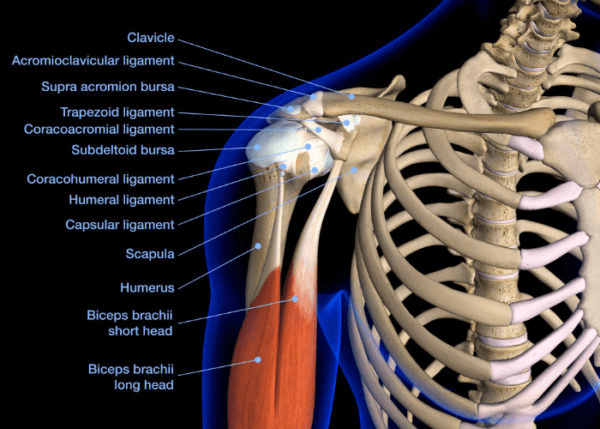
💪 The Bicep Tendon Complex
A Simple Explanation for a Common Shoulder Issue
A Bicep Tendon Complex (BTC) is a collection of issues throughout the shoulder that often leads to misdiagnosis and ineffective treatment.
This article is written to make this exceptionally common shoulder condition easier to understand.
⚠️ First, What Is It?
The term “Bicep Tendon Complex” isn’t an official diagnosis—it’s an in-house macro we use to describe a predictable, multi-step shoulder reaction pattern.
It’s the most common shoulder complex we treat in our clinic.
And it’s a huge part of sports injuries, mobility issues, and performance decreases—especially in overhead athletes like:
-
Baseball & softball players
-
Volleyball hitters
-
Swimmers
-
Tennis & pickleball players
🧠 Modern Movement Science: The Body’s “Threat Response”
Every body part reacts a little differently to perceived threat.
In the case of the shoulder, when your brain senses something’s wrong, it activates a built-in protection mechanism:
The Pec muscle contracts and “locks down” the shoulder.
This puts your arm into a slightly:
-
Internally rotated
-
Forward-rolled
-
Flexed position
It feels better because it feels safer.
Your brain is just trying to protect the joint—whether the issue was:
-
A bad night’s sleep
-
Overuse in a game
-
A random slip or strain
The pec clamps down, and shoulder mobility is immediately limited.
🔄 The Cascade Begins
Here’s what happens next (this is the complex part):
-
The pec shortens and pulls on the clavicle.
-
The humeral head (the ball of your shoulder joint) shifts forward.
-
The muscles on the back side of your shoulder—rotator cuff, traps, rhomboids—get pulled into an elongated, over-stretched position.
Now you’ve got:
-
Tight and short muscles in the front
-
Tight (but long) muscles in the back
This imbalance often pulls the bicep tendons (long head and short head) slightly out of alignment. These tendons live near the supraspinatus—one of your rotator cuff muscles—so people often mistake BTC for a rotator cuff tear.
“Doc, I think I tore my rotator cuff. It hurts right here!”
That’s the long head of the bicep tendon, my friend. And a much better finding.
🧩 It’s a Complex, Not a Crisis
BTC isn’t a single injury—it’s a series of reactions.
One thing leads to the next… and then the next.
It doesn’t mean your shoulder is ruined.
It just means it’s complicated enough that we need to treat it step by step.
✅ The Good News?
This is a simple process when done correctly.
But…
It’s just not something we can “pop” away.
🚫 Pop Culture vs. Real Treatment
Yeah, I’ve seen the TikTok and Instagram clips too.
You know the ones—where someone gets one shoulder pop, the doc does a dance, and everything is cured.
But that’s not reality.
“You’re going to get some joint movement—that’s a big part of this.
But if all I do is pop your shoulder and moonwalk out of the room to hip-hop, you’re not going to get better.”
🗓️ The BTC Protocol: 2 Visits, 1 Week
I’ve been using this protocol for nearly two decades, and the success rate is excellent.
Here’s the only caveat:
I now tell every patient upfront what to expect—or better yet, I link them directly to this article.
Because when you’re:
-
In pain
-
Wondering about cost
-
Not sure why a chiropractor is looking at your shoulder
-
Bracing for a sales pitch
You usually only absorb 2% of what I say.
You’re HOPING for a miracle.
But hope is a terrible treatment plan.
🛠️ So What’s the Fix?
Here’s how we unwind the complex:
1. Relax the front side
Especially the pec and anterior shoulder chain.
If this has been going on for more than 2–3 weeks, we may need to do an adhesion release on the underside of the pec.
Heads up—it doesn’t feel great.
But it’s absolutely necessary to restore proper shoulder mechanics.
2. Activate the back side
The posterior muscles—rotator cuff, traps, rhomboids—are already too long and underactive.
We activate them so they can do their job again.
This is not about stretching—it’s about control and reactivation.
3. Adjust the structure
We typically adjust the:
-
Clavicle
-
Humeral head (shoulder joint)
-
Upper thoracic spine
-
Lower cervical spine
Yes, chiropractic is part of this.
But it’s not just “alignment”—because alignment isn’t the root issue.
4. Set the tendons
This is the final step.
We don’t even bother touching the tendons until the shoulder mechanics are corrected.
🎯 Results?
Most patients experience:
-
Noticeable pain reduction
-
A significant return of shoulder mobility
…within the first visit.
Come back within a week, we repeat the process, and you’re usually back in business.
🔁 BTC: Tune-Up, Not Breakdown
We see this so often, I consider it a normal finding in active people.
This is human maintenance, not a “bad shoulder.”
If you work out, lift weights, or do overhead sports—you’ll likely experience BTC once a year.
If you’re an overhead athlete (baseball, volleyball, swimming, etc.), I expect to see BTC 2–3 times a year.
📣 Final Thoughts
The Bicep Tendon Complex is:
-
Common
-
Treatable
-
Non-surgical
-
And rarely serious
It just takes a step-by-step approach, not a pop-and-pray solution.
This article was created to help explain the mechanism behind a common shoulder issue, and to help patients understand what we do in our clinic.
This is not intended to diagnose or treat any individual without an exam.
If you’re experiencing shoulder pain, contact a qualified provider—or reach out directly to our clinic.
Let’s fix it the right way.