Athletic Durability Training | Build Armor Against Fatigue
By Dr. Chad Peters | Precision Performance Concepts
Why Durability Matters in Sports
Durability is resisting fatigue in all its forms. It is not just lungs and legs. Fatigue attacks your brain, your joints, and your nervous system.
Armor is not flashy. But armor is what lets you keep firing when everyone else has dropped their weapon. If you want to separate yourself at the end of a game or in the late stages of a season, durability training is your competitive edge.
Isometrics = Steel Plates on Joints
What it is: Holding positions under tension such as wall sits, planks, split squats, or push-up holds.
Why it works: Builds tendon and ligament toughness — the kind of strength that lasts deep into the fourth quarter.
Pro move: NBA and UFC athletes are programming 30–45 second isometric holds between heavy lifts. The result is joints that stay locked and stable even when tired.
Try this: After your workout, perform 3 rounds of a 30 second wall sit holding a medicine ball overhead. Legs burn, core locks, shoulders brace — full armor activation.
Chaos Training = Impact Insurance
What it is: Adding unpredictability to drills — partner shoves, reaction bands, unstable surfaces, resisted sprints with random release.
Why it works: Games are not predictable. Training should not be either. Chaos forces stabilizers and reflexes to fire under pressure.
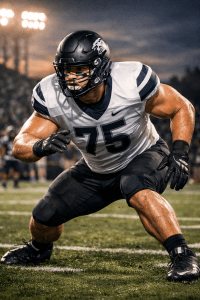
Pro move: NFL offensive linemen practice with heavy bands pulling them sideways while striking a sled.
Try this: Sprint while a partner tugs on your shirt for 5 yards, then suddenly lets go. Your body has to absorb and recover instantly.
Cognitive Load Drills = Anti-Mental Fatigue
What it is: Combining decision-making with physical work such as reaction lights, verbal cues, or math problems mid-drill.
Why it works: Most breakdowns happen when the brain lags. By training “fatigue-proof focus,” you keep making smart decisions even when exhausted.
Pro move: EPL soccer clubs use FitLight reaction pods to force players to make reads after repeated sprints.
Try this: Have a partner call “left” or “right” in the middle of a shuttle run. You react instantly. Simple, free, and brutal.
Contrast Recovery = Reset Faster
What it is: Alternating hot and cold exposure through plunges, saunas, or showers.
Why it works: Trains blood vessels to expand and contract which improves nutrient delivery and waste clearance. Recovery equals durability over the course of a season.
Pro move: NBA athletes rotate between 2 minutes in a cold plunge and 10 minutes in a hot tub, for 3–4 rounds after games.
Try this: No hot tub? Use a contrast shower. One minute cold, two minutes hot, repeated for 3–5 cycles.
Micro-Dosing Workloads = Armor Maintenance
What it is: Adding small “durability snacks” daily instead of relying on giant grind sessions.
Why it works: Consistency beats punishment. Daily reinforcement prevents cracks from forming.
Pro move: MLB pitchers perform 10-minute mobility and band circuits every day, even on off-days.
Try this: Add a 10-minute morning routine. Five minutes of hip mobility plus five minutes of core activation. Tiny doses create long-term armor.
Collagen and Vitamin C Pre-Load = Joint Sealant
What it is: 10–15 grams of gelatin or collagen paired with Vitamin C one hour before training or competition.
Why it works: Collagen peptides combined with Vitamin C stimulate collagen synthesis which toughens tendons and ligaments.
Pro move: EPL and NBA strength coaches are sliding collagen shakes into pre-practice warm-ups.
Try this: Mix a packet of gelatin with orange juice. Old-school approach backed by modern science.
Field Manual Closing: Why Armor Wins the Long Game
Armor alone will not win the battle. But it ensures you are still in the battle.
Athletes who train durability do not fade. They think clearly under pressure. They collide with force. They accelerate when everyone else is exhausted.
Durability training is not just about surviving. It is about having the strength, stability, and focus to dominate when it matters most.
Related