The Anterior Rib:
By: Dr. Chad Peters | Precision Performance Concepts
It’s often stated:
You can have many problems in your life, but when you have a health issue, you have only one.
And in the grand scheme of things, although this issue is a small problem, the pain involved grabs your full and undivided attention.
Understanding Anterior Rib Pain
Rib injuries are simple in structure but brutal in impact. When ribs are functioning normally, they move with your breath and barely make their presence known. When a rib stops functioning correctly, that tiny change becomes a major problem in your life.
The pain with the anterior rib version is often sharp, deep, or pressure based.
It usually sits right along the sternum or just off to one side.
Many people describe it as annoying, distracting, or strangely persistent. Others describe it as the kind of pain that hijacks your entire day.
Two of the most common complaints I hear are:
“It hurts to take a deep breath.”
“It feels like a knife in my chest.”
Before going deeper, I recommend reading my basic rib injury article. If taking a deep breath hurts, feels stuck, or creates a sharp catch, that is often the simplest definition of a rib issue. The anterior rib is the same story, just felt on the front of the chest.
What Is an Anterior Rib Issue
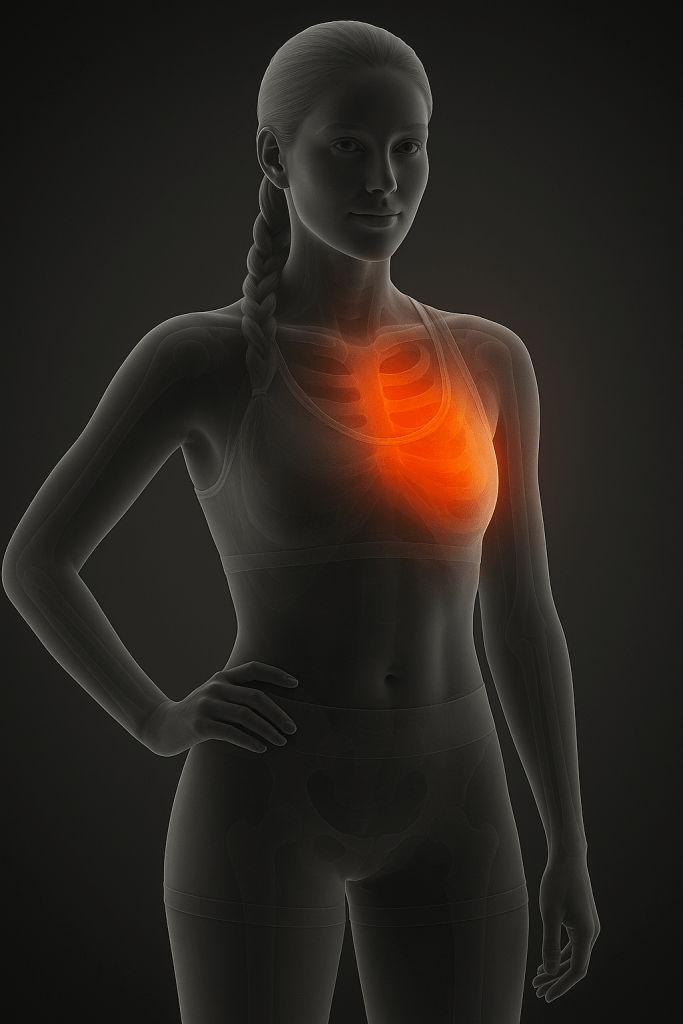
The anterior rib is commonly felt along the sternum, usually around the 4th, 5th, or 6th rib level. The pain may flare with coughing, sneezing, stretching, or trying to take a deep breath.
It is almost always musculoskeletal in nature, not cardiopulmonary.
It does not come with radiation down the arm, fainting, or pressure during exertion.
Instead, you get something very specific:
It feels like it needs to pop.
I have heard that same description for two decades in practice. After dealing with my own rib problem recently, I can fully agree. That sensation is real, and incredibly frustrating.
Why It Feels Like It Needs to Pop Every Day
When the rib becomes irritated or slightly displaced, it stops gliding smoothly. That disruption causes abnormal feedback to the brain. The body reacts by tightening the muscles around it in an effort to stabilize the area.
This creates the constant urge to pop or crack the rib.
Most people stretch, twist, lean on a chair, push with their fingers, or actively try to release it multiple times a day. When it pops, it feels good for a moment. But the relief never lasts.
Here is why:
You are increasing mobility in an area that actually needs stability.
Every time you pop it:
• you loosen it a little more
• the brain reads the extra mobility as a threat
• the muscles tighten even harder
• the problem resets back to day one
I made this same mistake. My wife, who is also a chiropractor, adjusted my rib daily for a week. It never improved because I was doing the exact opposite of what the area needed.
How Fear Works with Injury and why Understanding is the cure.
(The Fear Loop)
If two decades of working with athletes has proven anything to me, it is this: not understanding an issue always makes the problem last longer.
When you are in pain, the body reacts with fear.
Pain near the chest creates an even bigger fear response because this area as important and vulnerable.
Fear increases tension.
Tension increases sensitivity.
Sensitivity increases pain.
Pain increases fear.
That cycle is the fear loop, and it makes every sensation feel louder and more threatening than it actually is.
When you understand what is happening, the fear drops.
The pain may still be there, but it no longer feels threatening.
Once the threat eases, the whole system calms down. Breathing improves. Muscles stop bracing. The brain steps out of protect mode.
Recovery speeds up.
This is the entire reason I write these injury pages.
Understanding reduces fear. Fear reduction speeds recovery.
How We Treat Anterior Rib Pain
This is a very predictable injury pattern. The treatment is simple, effective, and follows a sequence.
1. Moist heat for 5 to 6 minutes
We apply moist heat over the area to relax the intercostal muscles and reduce discomfort during the adjustment. This is not for inflammation. It is simply to help the tissue relax so the treatment does not spike sensitivity.
2. Gentle anterior rib adjustment (A to P)
Using a drop piece, we adjust the anterior rib where it meets the sternum. The motion is specific and controlled.
3. Posterior rib and thoracic adjustment
Ribs attach at the front and the back. You cannot correct the front without balancing the back. We adjust the rib head posteriorly at the thoracic spine.
4. Pec release and activation of the posterior chain
Tight pecs often pull the rib forward. We release the pec muscles manually or with vibration therapy, then activate the posterior rib area with rowing reps if tolerated.
5. EMS and ice for 10 to 15 minutes
We finish with ice to minimize inflammation. This prevents the rib from locking back down and allows the body to reset more effectively. EMS helps relax the deeper intercostal muscles.
This approach consistently gets results in just a few visits.
Why Inflammation Prolongs Rib Pain
This is not a heat versus ice debate.
The decision is based entirely on the threat response and what works best.
When an anterior rib is irritated, the body is already in a protective, reactive state. More inflammation increases pressure, increases sensitivity, and tells the brain something is wrong.
The brain responds with more muscle guarding.
The guarding feeds the pain.
The pain feeds the guarding.
And the cycle loops again.
Ice helps interrupt that loop.
Many patients notice improvement when using over the counter anti inflammatories. This is not a prescription. Chiropractors in Texas cannot prescribe medications.
If anti-inflammatories help, that is a clue that inflammation is playing a role.
How Long Does Recovery Take
Most anterior rib issues respond quickly.
Two to three visits is typical.
My recommendation is:
• back to back treatment days when possible
• ice at home
• avoid self popping
• stay ahead of inflammation
The less you irritate it, the faster it resolves.
When You Should Seek Medical Evaluation
Anterior rib pain can mimic more serious chest conditions. If you are unsure, always err on the safe side. Get checked first. If your doctor confirms it is musculoskeletal, chiropractic care and other physio based practitioners (Athletic Trainers, Physios, DO and PT) with experience in acute care become excellent options.
Final Thoughts
Anterior rib pain can be one of the most aggravating injuries you will ever experience. It commands attention. It disrupts sleep. It makes breathing uncomfortable. But the good news is that it is also one of the most predictable and treatable issues we see.
With proper workup, reduced inflammation, and restored function, most people feel significantly better within days.
This article is for information only. It is not a diagnosis.
If this helps you better understand what is happening inside your own body, then the goal is met.
Rib injuries are small.
The pain is big.
The fix is usually simple.