A Better Explanation — And What You Actually Need to Know
It’s one of the most common injuries in sports. A huge part of what we see in my office, and something athletic trainers, physios, and PTs deal with worldwide.
It’s one of the most basic and best-understood injuries. It’s also one of the most over-iced, over-rested, under-rehabbed, and flat-out misunderstood.
You rolled your ankle. Maybe you heard a pop. Maybe it swelled up immediately. Maybe somebody told you,
“It’s just a sprain.”
And somehow, that makes it sound like it doesn’t really matter.
It does.
Let’s break this down my way — with zero fluff and no dated advice.
First things first: if you have this sort of injury, I think chiropractic is wonderful. A sports doc like me looks at these issues as bread and butter. It’s what I do.
But just because I am a chiropractor, don’t hope there is some kind of magic pop that instantly fixes these issues. This is tissue — not alignment. It takes a little time to fix and heal tissue.
❓ First — Explanation and Understanding makes recovery faster. Learn.
A sprain is an injury to a ligament. Ligaments connect bone to bone.
So when you sprain your ankle, one or more of the ligaments supporting that ankle have been stretched beyond what they were ready to handle.
But let’s be real — in most real-life injuries, it’s rarely just one tiny easy diagnosis and structure. The body is complex and a better understanding is a combination of tissue overload, swelling, altered movement, muscle guarding, and brain-body confusion.
🧵 So… Is It Torn?
Technically? Yes.
Like almost every injury, there is a spectrum.
Grade 1 is low grade. Think: ankle rolled while playing basketball.
Grade 2 is more significant. There is more tissue damage, more swelling, and it may take several weeks to recover.
Grade 3 is a complete rupture.
For this article, we’re talking about the low-grade Grade 1 sprain.
Technically, I can call it a partial tear. That’s accurate. But it’s also scary, and honestly, it often sounds way more severe than what it actually is.
But, as an athlete, which would you rather hear?
“Grade 1 partial tear of the talofibular ligament complex.”
Or:
“You sprained your ankle.”
Terminology matters.
I have seen way too many athletes struggle to come back from a low-level injury because they were given a high-level technical sounding diagnosis.
So let’s just call it a sprained ankle, okay?
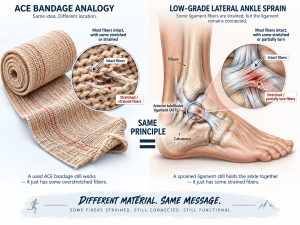
🩹 The ACE Bandage Analogy
Here’s how I explain it in clinic:
Picture an old ACE bandage — one you’ve used way too many times. It’s frayed. Worn out. Some of the threads are stretched. Some are torn.
That’s your ligament after an ankle sprain.
It’s not nec
essarily a full-blown tear, and it’s not necessarily surgical. But it is weakened
and compromised. It’s still holding together and still doing its job — but it is injured, irritated, and not behaving exactly like it used to.
And now it needs some help: stability, time, movement, and re-patterning.
💥 How It Happens
There are two big mechanisms.
1. The Long Stretch
Think about an awkward step or slowly rolling the ankle farther than it wants to go. The tissue gets pulled past its limit — not necessarily violently, just too far.
2. The Fast Stretch
Landing on somebody else’s foot. Cutting quickly and having the ankle roll. Stepping in a hole.
The ligament doesn’t have time to react or brace. It gets stretched fast, almost like a whip.
Both can create the same basic result: a stressed, irritated, partially damaged ligament that your body doesn’t completely trust anymore.
🧠 Here’s What Most People Get Wrong
You iced it. You rested it. You wrapped it. Maybe you stayed off it for a few days. Maybe you took some ibuprofen.
And then you waited.
But you never actually reset the pattern.
Your body responds to injury with a built-in safety program:
It locks down motion. Muscles tighten to protect. Range of motion disappears. Compensation starts.
That makes sense early. Your body is trying to protect you.
But if that protective pattern sticks around too long, you end up with an ankle that is technically “healed” but still doesn’t move, balance, react, or feel the way it did before. The sprain may be better but now you have a pattern and body problem.
That’s where people get in trouble. That’s why the ankle keeps rolling again. That’s why six months later somebody still says:
“It just doesn’t feel right.”
🚫 BUT…Also – Don’t Do This
- Don’t immediately start aggressively stretching it.
- Don’t test your max strength just to “see if it’s better.”
- Don’t assume rest means recovery.
- Don’t stay off it for six weeks and then jump straight back into full-speed sport.
- Don’t assume swelling disappearing means the ankle is completely rehabilitated.
That’s how a small ankle sprain becomes a much bigger problem.
✅ What You Should Do
Here’s how I guide recovery in my office. and this is step by step, not – do all 4 today!
1. Calm the Threat
Early on, your ankle may be swollen, painful, guarded, and angry.
Use ice and gentle compression when appropriate to help manage pain and swelling. But the goal isn’t just to numb it. The goal is to calm the system enough that your brain starts allowing normal movement again.
It has become very common to suggest Heat not Ice – I hate that debate (if you want to fight that fight read this first...)
but at stage 1 I always suggest ice first, not as much for the inflammation as the THREAT RESPONSE – You don’t want your ankle living in protection mode forever. You have ti stop the threat before the moving through the steps.
2. Rebuild Basic Motion After the THREAT Response Is Taken Care Of
This is where simple movement starts: I always use Ankle ABCs, just start by taking your ankle through a gentle range of motion, and movement by spelling out the ABC’s and add more motion and bigger movement as you improve. This helps your brain re-establish a “safe zone.”
The goal isn’t maximum strength yet. The goal is reconnecting the circuit.
Motion tells the brain:
“Hey. We’re okay. You can start using this again.”
3. Rewire the Movement Map
This is the part that gets missed all the time and where everybody stops. “Hey it feels good, a doctor signed the release, i must be ready to play tennis again?!”
Agh…You’re not only healing tissue. You’re retraining movement, reaction, and trust.
In clinic, we start layering in things like:
- Balance drills
- Single-leg work
- Isolated muscle contractions
- Toe spreading, curling, and lifting
- Slow, controlled movement
- Proprioceptive drills
- Visual feedback
- Unstable surfaces
- Changes in direction
Because the brain needs to relearn where that ankle is in space.
That matters. A lot.
4. Gradually Reload
Once motion is improving and the ankle is controlling itself better, now we start adding real load: strength, eccentric work, single-leg control, power, jumping, landing, cutting, running, and sport-specific movement.
Eventually, we add movement under fatigue.
But only after the basics are there.
You don’t build the roof before the foundation.
5 – Return to Play
You need a note to “be released?” No.
How about a note to start the return to play protocol with the guidance of yourself, your athletic trainer and a coach or two,
Wait. You’ve never heard of Return To Play? I’m so glad you asked… (link here!)
🧬 Final Word
An ankle sprain is common. But common doesn’t mean meaningless, and “just a sprain” doesn’t mean “do nothing.”
It is damage to tissue and damage to trust — and both need to be rebuilt.
You can’t completely shortcut it. You can’t rest your way into perfect function. And you definitely can’t fix it by aggressively stretching the crap out of it.
Our understanding of these injuries has changed. Treatment has changed. Rehabilitation has changed.
That is what this entire website is about — keeping athletes, parents, coaches, and patients modern.
So the next time you roll your ankle, don’t freak out — but don’t ignore it either.
Respect the ACE bandage analogy. Stop the Threat. Restore the motion. Rebuild the trust. And get back to work.