The Athlete Tax
If you hang out in any clinic, weight room, or beer league dugout long enough, you hear the same line over and over.
“I could have played in college if something had not gotten in the way.”
Injuries.
A coach who did not like me.
Bad grades.
Life stuff.
Sometimes those reasons are real.
A lot of times, they are incomplete.
There is a piece almost nobody talks about out loud.
Only Six Percent
Only about 6 percent of high school athletes go on to play in college.
Six percent.
That does not mean the other 94 percent were simply not good enough.
It means there is a price you pay to get into that club, and most people do not know that price exists or are not willing to pay it.
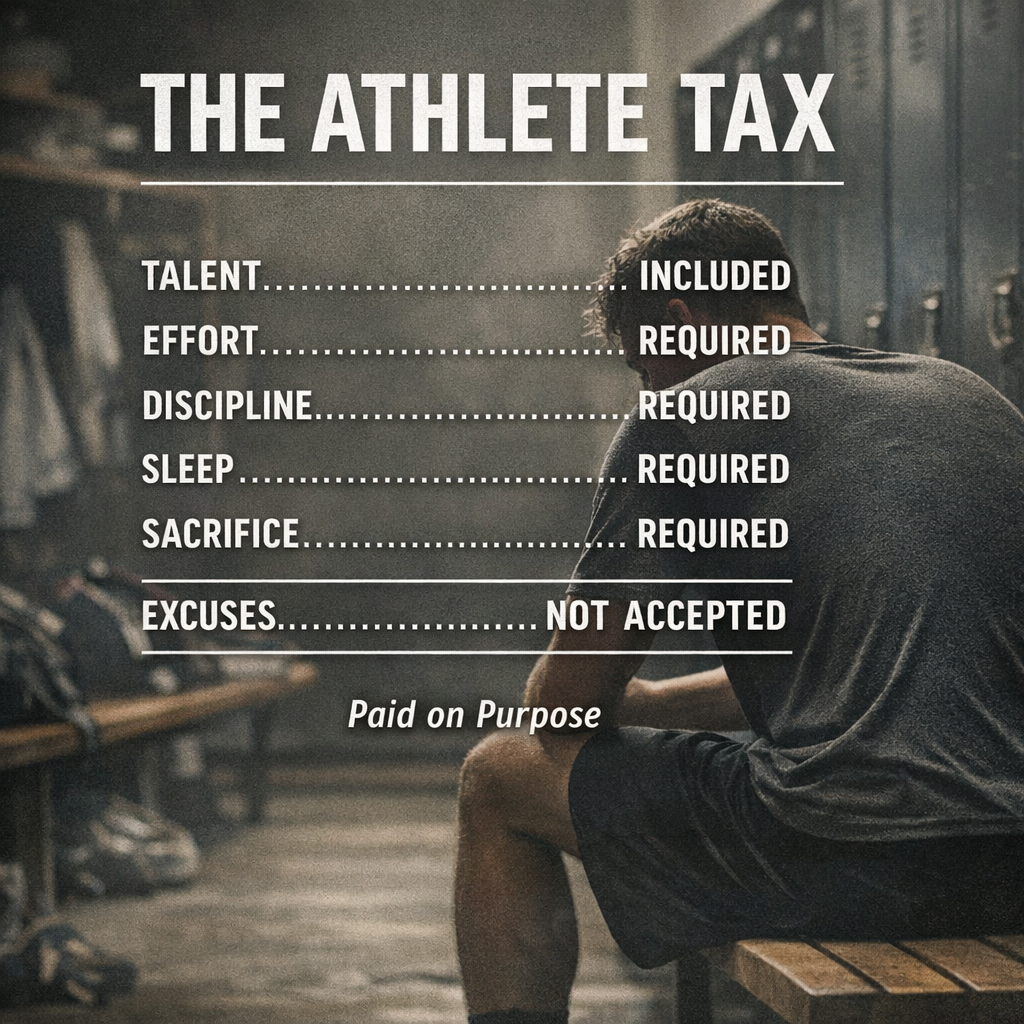
That price is what I call the athlete tax.
This article is not meant to scare you off.
It is meant to give you a clearer picture so you can decide on purpose.
Think About It Like Sales Tax
Anywhere in America, if you buy a Coke, a hotel room, or a new pair of shoes, you pay the listed price plus tax.
You do not have to like it.
You do not have to clap for it.
But if you want the thing, you pay it.
College athletics works the same way.
If you want the experience of being a college athlete: the travel, the locker room, the jersey with your name on it, the higher level of competition, there is a cost. It is not just talent. It is not just wanting it.
A lot of the other 94 percent want it.
What the Athlete Tax Is Really Paid In
The athlete tax is not one thing.
It is paid daily in:
Time
Energy
Focus
Consistency
But even more importantly, it is paid in:
What you say “no” to:
How you structure your day, How much you go out, Parties, How you recover instead of just survive, How you think when nobody is watching.
Everything in life has a tax.
The difference is deciding which ones you are willing to pay.
Talent Is Your Ticket, Not Your Tax
Unless you are a true outlier, the kind of athlete who shows up once in a generation, talent alone is not enough.
College sports are filled with athletes who were the best kid on their team at some point. Everyone was all-state.
Talent gets you noticed.
The tax is everything you add on top of it.
That includes:
Extra work nobody forces you to do
Smarter decisions about sleep, food, and screens
Learning to love boring, repeatable habits
Looking for small edges instead of big miracles
You cannot just kind of want it.
And you cannot outsource the tax to a trainer and assume it is covered.
Paying the Tax on Purpose
Paying the athlete tax does not mean being miserable.
It is not:
Grinding nonstop
Hating your life now to enjoy it later
Sacrificing everything to prove toughness
The athletes who last do not pay the tax angrily.
They pay it intentionally.
“This is the price I pay because I want a different experience.”
That mindset changes everything.
The tax becomes a badge of pride, not a burden.
The Benefits Package Nobody Talks About
If there is a cost, there should also be a return.
Being a college athlete comes with benefits most people never experience.
A Level of Team You May Never Find Again
You are part of something demanding and shared.
Locker rooms.
Bus rides.
Wins that feel electric.
Losses that hurt but bond you.
Those relationships last long after the last game.
Let’s Be Honest, It Is Cool
College is less cliquey than high school, but being on a roster still means something.
You end up around driven people.
People who expect more from themselves.
People who raise your standards without saying a word.
That environment changes how you think and what you believe is normal.
Your Body at the Right Time
College happens during a rare physical window.
Your hormones, growth, and recovery potential are all lined up.
Done well, this is your best chance to:
Build real strength
Move better than ever
Learn how your body works
Push speed and power safely
Unlock you Athletic Potential!
Athletes tend to look better, move better, and test the limits of what the human body was built to do.
Life Lessons Compressed
Sports teach life faster than almost anything else.
Effort changes outcomes.
You can do things right and still lose.
You learn to handle criticism in public.
You show up when tired, sore, stressed, or unsure.
In my clinic, I overwhelmingly hire former athletes.
They handle feedback better.
They want to improve.
They understand team dynamics.
They aim for mastery, not just good enough.
Those traits carry far beyond sports.
A Conversation With Your Future Self
Imagine talking to yourself 20 years from now.
Maybe you are a parent.
Maybe you have a career you care about.
Maybe your knees crack a little when you stand up.
Ask that version of you:
“Are you glad we paid the tax and went for it?”
Or:
“Are you still a little mad we never truly tried?”
That answer matters.
This article is not saying everyone should play college sports.
It is saying you deserve to make the decision with your eyes open.
If You Are in High School Right Now
If you are 16 to 18 and this hits close to home, it is time to think differently.
No one is forcing you to:
Build a real schedule
Protect your sleep
Train with intention
Take care of your body
The athlete tax is paid quietly.
Here are a few starting points.
Audit Your Day
Where are you leaking time and energy?
Late nights scrolling.
Skipped mobility.
Half effort lifts.
Poor food choices.
Those are unpaid taxes.
Choose a Few Non-Negotiables
Sleep window.
Daily mobility.
One extra skill session per week.
Better hydration and protein choices.
Small, boring, consistent.
Protect Your Body
Handle small injuries early.
Learn basic strength and movement quality.
Recovery is not weakness. It is strategy.
Learn to Enjoy the Process
If you hate all of it, the road will be rough.
The athletes who last are the ones who fall in love with the work, not just the highlights.
Final Word
This is not about guilt.
It is not saying you failed if you do not play in college. It’s not for everybody.
It is saying this:
If you want that experience, there is a price to pay.
You will pay it in time, focus, choices, and effort. You will pay it both in adding extra assets and in discarding more detriments.
The question is not can you.
The question is, “Will you pay it on purpose?”