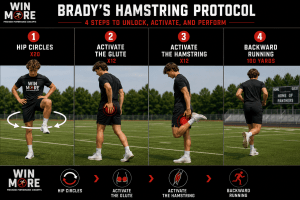
🦵 Hamstring Strains — Fix It Smarter, Not Harder
You’re sprinting.
You jump.
You land.
You feel it — that sudden zing down the back of your thigh. Cue the limp, the grab, the frustration.
Welcome to the club.
Hamstring strains happen to almost everyone at some point — athletes, weekend warriors, even well-meaning New Year’s Resolution gym-goers.
But what’s changed dramatically over the past two decades is how we treat them.
If you’re still stretching and heating your way through a hammy strain — you’re doing it backwards.
🔁 A Quick Look Back
If you’re old enough to remember Olympic sprinters in the early 2000s, you’ll recall the classic moment:
Runner pulls up mid-race, grabs their thigh, collapses.
Trainer runs out, lays them on their back, and launches into the “catapult stretch” — one leg straight on the ground, the other yanked toward the sky.
It looked decisive. Professional. Heroic, even.
It was also completely wrong.

❌ What’s Wrong with the Old Approach?
Because hamstring strains involve sudden overstretch or overload, the LAST thing you want to do is… stretch it again.
The muscle is:
-
Torn or strained
-
Inflamed
-
Guarding to protect itself
When you add more length to a damaged structure, you’re:
-
Delaying healing
-
Reinforcing pain
-
Sometimes making the tear worse
And here’s the deeper layer most people miss:
🧠 The majority of hamstring strains occur during a long stretch or a fast stretch event.
Think about the moment you got hurt —
-
Sprinting at top speed
-
Lunging for a ball
-
Jumping into a split stance
-
Slipping while running or decelerating
Those are all sudden, high-speed elongations of the hamstring. That’s what tore it.
So what do we often do after the injury?
We recreate the very mechanism that caused the injury — lying on our backs and cranking the leg skyward to “loosen it up.”
If a long or fast stretch caused the injury…
A long or fast stretch isn’t going to heal it.
It’s going to reinforce the alarm system.
✅ Instead of a debate on the merits of heat or ice – let’s change the perspective by introducing a new concept:
“THREAT RESPONSE.”
Modern Treatment = Calm the system. Then build trust back into the tissue.
Here’s the framework we use in the clinic:
With a new Injury, The Hamstring is “threatened.”
The threat response supersedes the debate on heat or ice.
1️⃣ ICE FIRST
Inflammation is the primary barrier to healing.
Use direct ice over the site of pain — 10–12 minutes, multiple times per day.
This helps:
-
Lower swelling
-
Reduce spasm
-
Interrupt the “threat loop” in your nervous system
2️⃣ CONTRACTION BEFORE STRETCH
This is the game-changer.
Instead of yanking the muscle longer, we cue it to contract lightly — even while injured.
Examples:
-
Supine hamstring curl with your heel on the wall
-
Light foot digs into the floor
-
Gentle bridges with limited range
The idea is to tell your brain:
“We’re still in control of this muscle.”
That control = trust.
And trust = healing.
This also helps the brain separate stretch reflex from injury memory.
⚠️ Types of Hamstring Injuries Vary
Not all hamstring injuries are created equal.
Some are:
-
High proximal strains (near the glute)
-
Belly tears (middle of the thigh)
-
Distal issues (behind the knee)
-
Tendinous overload (from chronic sprinting or lifting)
While this article gives you the framework, a proper clinical evaluation is always best.
If your symptoms linger or worsen, seek a hands-on assessment.
🧠 What Makes This Hard Mentally
A hamstring injury feels like it wants to be stretched.
It feels like something is “tight” or “stuck.”
That sensation is a protective response, not a lack of flexibility.
Stretching gives short-term relief — but re-triggers the threat.
You have to rebuild motor control, not just chase sensation.
And that means starting with low-level, confident movement, not yanking into end range.
🎯 Final Takeaways
✅ Ice it.
✅ Don’t stretch it — especially early.
✅ Reintroduce light contractions.
✅ Progress to range and strength only after the muscle calms down.
✅ Get a real diagnosis if it’s not improving.
It’s the future. Understanding and treatment have changed significantly. This entire website is built to keep you modern.
Don’t let old-school treatment methods keep you stuck in a re-injury cycle.
Do it right.
Heal smarter.
And get back to full speed — without repeating the same mistake next season.